Palms
A palm first says warmth: the tropics, coasts, oases. Coconut palms hug tropical beaches, date palms irrigated deserts, and a palm planted in a town outside the tropics often points to a Mediterranean climate or a landscaped seafront. Look at the frond: feather or fan already changes the list.
Coconut palm
Cocos nucifera · Feather palm
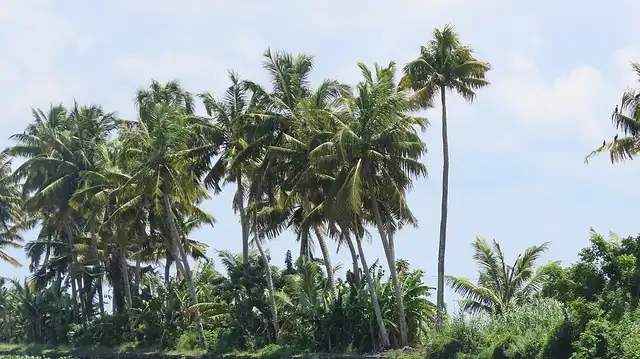
The palm of tropical shores, planted wherever it is warm enough.
- ADULT SIZE
- Up to 30 m tall.
- LEAVES
- Pinnate fronds 4–6 m long, with leaflets 60–90 cm long.
- BARK
- Old leaves break away cleanly, leaving the trunk smooth.
- FRUIT
- A full-sized nut weighs about 1.4 kg: rounded with a thin husk in the cultivated Pacific forms, elongated and triangular in the wild ones.
- IN PLAY
- It fences off the warm belt: seeing one rules out anywhere that freezes. But it is planted on nearly every tropical shore on earth, so it gives you the latitude and never the country — what settles that is whatever stands AROUND it.
- NATIVE
- American Samoa · Australia · Indonesia · Philippines
Oil palm
Elaeis guineensis · Feather palm
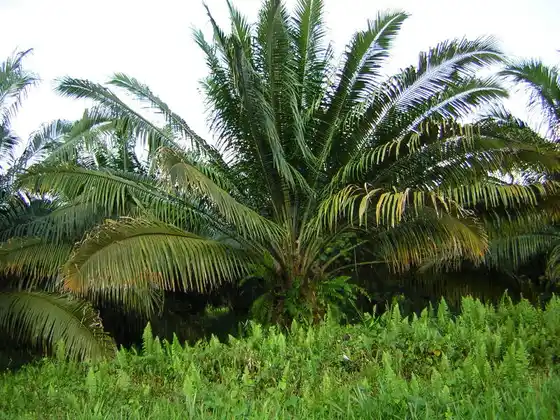
The palm of row plantations, from West Africa to Borneo.
- ADULT SIZE
- A single stem, up to 20 m tall.
- LEAVES
- Pinnate leaves 3–5 m long.
- BARK
- Cylindrical, upright, unbranched stem of constant diameter.
- FRUIT
- Reddish fruit the size of a large plum, in bunches of 5–30 kg.
- IN PLAY
- Palms in ruler-straight rows as far as the eye can see are almost always this one: Indonesia and Malaysia first, then West Africa, its home, and Central America. It only grows within twenty degrees of the equator.
- NATIVE
- Egypt · Ghana · Kenya · Nigeria · São Tomé and Príncipe · Senegal · Uganda
Areca palm
Areca catechu · Feather palm
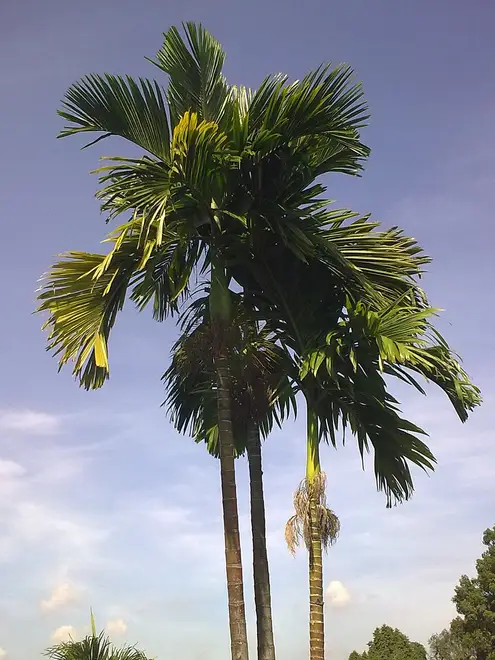
The mast-thin palm, planted for its nut across South Asia.
- ADULT SIZE
- 10–20 m tall, on a trunk barely 10–15 cm across.
- LEAVES
- A short crown of upright pinnate fronds, leaflets folded and uneven at the tip.
- BARK
- Smooth trunk, pale green towards the top, ringed at regular intervals.
- FRUIT
- The areca nut, orange when ripe, in clusters below the crown.
- IN PLAY
- Rows of thin masts in yards and along paddies: South India, Bangladesh, Indonesia. Its slimness tells it from coconut palms at a glance.
- NATIVE
- Philippines
Palmyra palm
Borassus flabellifer · Fan palm
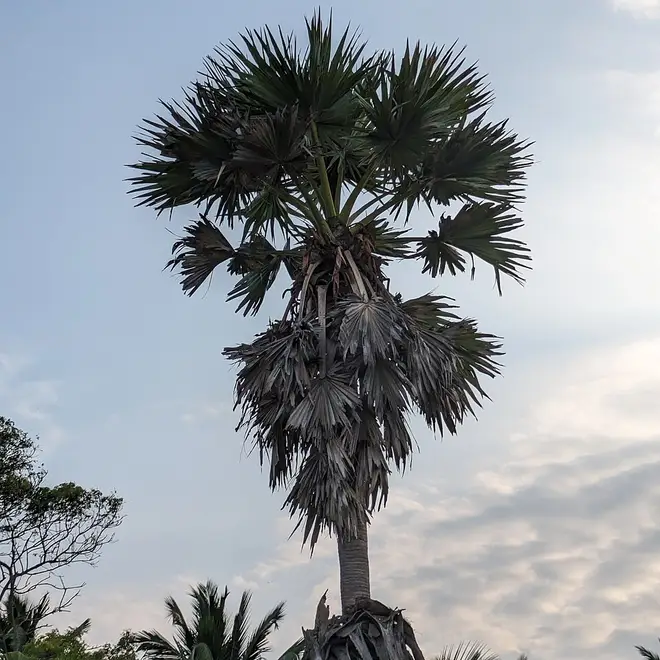
The great fan palm of Indian and Khmer countrysides.
- ADULT SIZE
- Up to 30 m, on a massive dark trunk.
- LEAVES
- Stiff fan-shaped fronds 2–3 m across, in a full rounded crown.
- BARK
- Grey-black trunk, often swollen at the base, tightly ringed with scars.
- FRUIT
- Large round purplish-black fruits in clusters, like small dark coconuts.
- IN PLAY
- Its lone fan silhouette amid paddies is THE postcard of Cambodia — and Tamil Nadu. A Borassus by a red-brown paddy leans South Asia, not Africa.
- NATIVE
- Bangladesh · Cambodia · India · Indonesia · Laos · Sri Lanka · Thailand · Vietnam
Date palm
Phoenix dactylifera · Feather palm
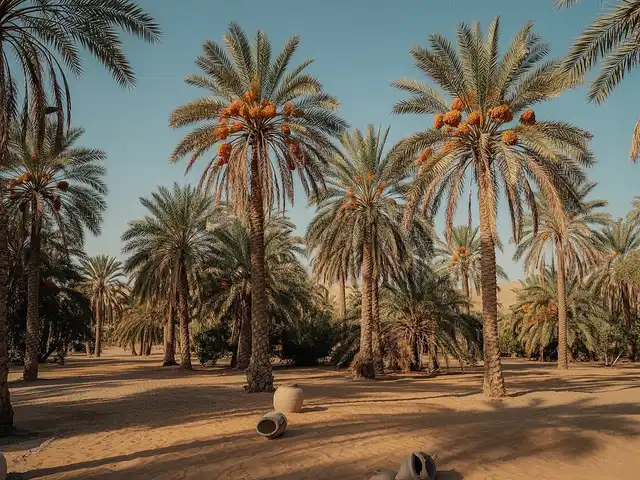
The palm of the oases, and of avenues across the dry world.
- ADULT SIZE
- Up to 30 m tall, with a crown 6–10 m across.
- LEAVES
- Pinnate fronds 4–6 m long with about 150 leaflets 30 cm long, and spines on the petiole.
- FRUIT
- An oval-cylindrical date 3–7 cm long, dark brown to bright red or yellow depending on the variety.
- IN PLAY
- An irrigated grove in the middle of dry country is an oasis: the Maghreb, Arabia, Iran, or the American deserts where it is planted. Trimmed in a row along an avenue it says nothing about climate any more — only that a town council wanted to look southern.
- NATIVE
- Oman · Qatar · United Arab Emirates
Silver date palm
Phoenix sylvestris · Feather palm
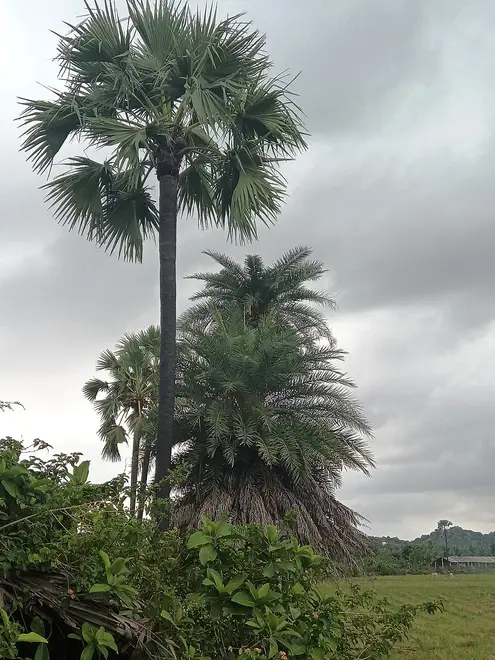
The palm-sugar date palm, lining the roads of Bangladesh and India.
- ADULT SIZE
- 4–15 m, on a single trunk about 40 cm across — smaller than the date palm, never clumping.
- LEAVES
- Up to a hundred gently recurved pinnate fronds 3 m long, with hard spines near the base; the crown reaches 10 m across.
- BARK
- A rough trunk, bristling with persistent leaf-stalk bases; tapped season after season on alternate sides, it keeps zigzag scars.
- FRUIT
- Small single-seeded dates, purple-red when ripe, smaller than true dates.
- IN PLAY
- A date palm by a green, humid road, far from any desert: that is the silver date palm, and you are in South Asia — Bangladesh above all, and the Indian plains. A zigzag-scarred trunk, cut every winter for the sap boiled down into gur (Bengal jaggery), gives it away better than anything. Smaller than the oasis date palm, and its bristly trunk looks nothing like the smooth trunk of a coconut.
- NATIVE
- Bangladesh · Bhutan · India · Nepal · Sri Lanka · Thailand
Makalani palm
Hyphaene petersiana · Fan palm
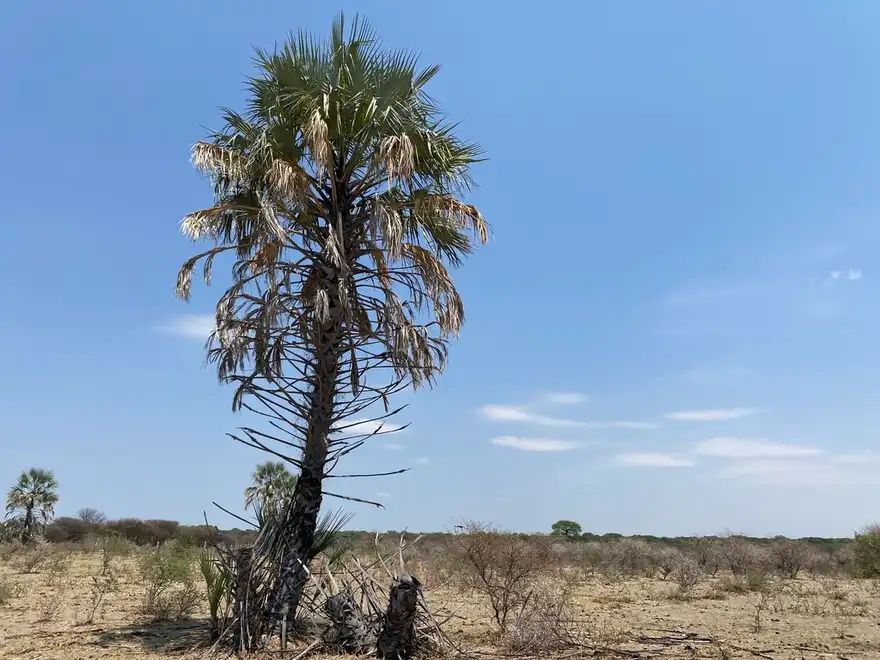
The palm of southern Africa’s savannas, often in groves near water.
- ADULT SIZE
- Up to 15–18 m, the trunk often slightly swollen at mid-height.
- LEAVES
- Stiff grey-green fans in a sparse crown.
- FRUIT
- Round brown ‘vegetable ivory’ fruits, hanging long in clusters.
- IN PLAY
- Lone fans over short savanna with huts in the distance: Botswana, northern Namibia, Zambia. THE palm of Okavango-country roads.
- NATIVE
- Botswana · Kenya · Namibia · Rwanda · South Africa · Uganda
Savannah palm
Sabal mauritiiformis · Fan palm
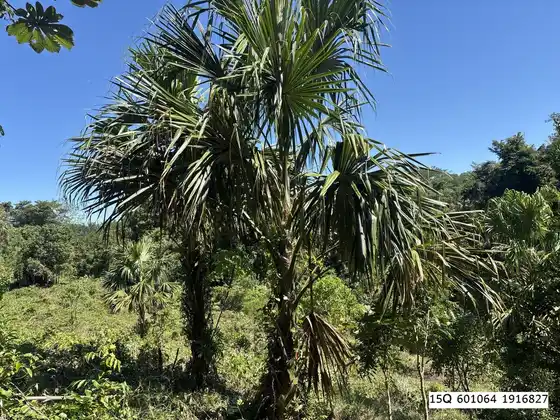
The tall fan of tropical America’s savannas and pastures.
- ADULT SIZE
- Up to 25 m, on a slim greyish trunk.
- LEAVES
- Costapalmate fans, deeply split, with drooping segments.
- IN PLAY
- Left standing in cleared pastures: a scatter of tall fans over short grass says Colombia, Venezuela or Panama.
- NATIVE
- Brazil · Colombia · Costa Rica · Guatemala · Mexico · Panama
Moriche palm
Mauritia flexuosa · Fan palm
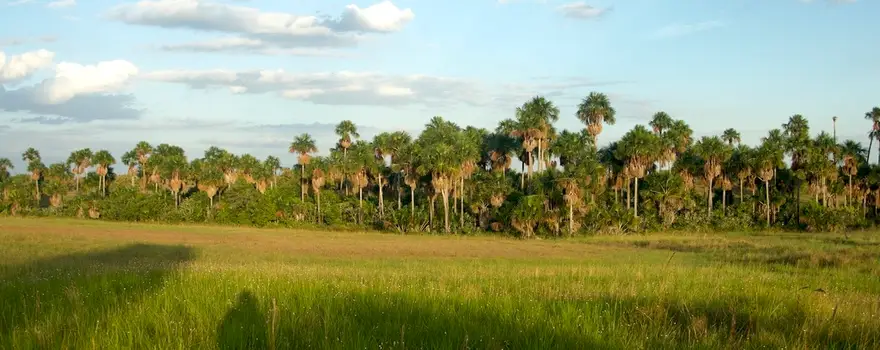
The buriti palm of flooded ground — the ‘morichales’ of Amazonia.
- ADULT SIZE
- Up to 25–30 m, on a smooth even trunk.
- LEAVES
- Huge costapalmate fans in a rounded crown.
- FRUIT
- Scaly red-brown fruits, like small pine cones.
- IN PLAY
- Whole colonies standing in water, in wet valley bottoms and swampy savanna: the Amazon basin and the llanos — never on dry ground.
- NATIVE
- Bolivia · Brazil · Colombia · Ecuador · France · Peru
Wine palm
Attalea butyracea · Feather palm
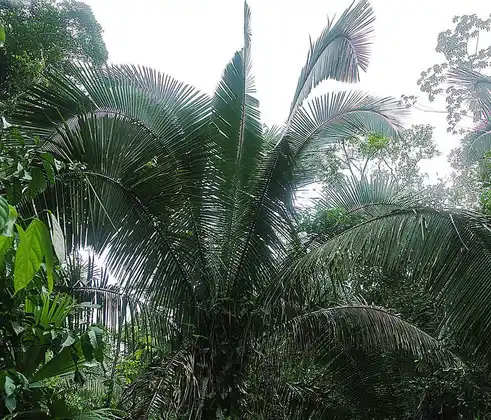
The tall wine palm of the plains, spared in the pastures.
- ADULT SIZE
- Up to 20–25 m, on a massive smooth trunk.
- LEAVES
- Very long pinnate fronds, upright then arching, leaflets in several planes.
- IN PLAY
- Scattered through the cattle pastures of Colombia and Venezuela: big lone plumes over green grass, cattle at their feet.
- NATIVE
- Bolivia · Brazil · Colombia · Costa Rica · Ecuador · Guatemala · Mexico · Panama · Peru
Mexican fan palm
Washingtonia robusta · Fan palm
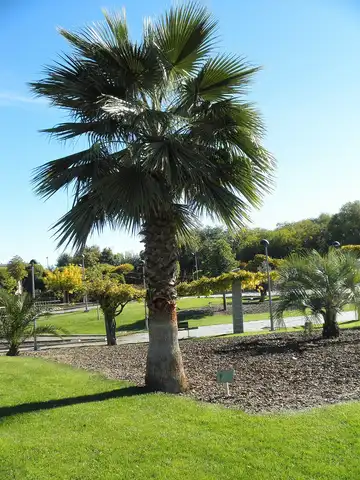
The tall feather-duster palm of avenues, from Mexico to the Mediterranean.
- ADULT SIZE
- Up to 25 m tall, rarely 30 m.
- LEAVES
- Fan leaves up to 1 m, on a petiole armed with sharp thorns.
- BARK
- A slender trunk, wider at the base; it keeps a “skirt” of dead leaves, usually trimmed in towns.
- FRUIT
- Small blue-black drupes 6–8 mm across.
- IN PLAY
- One of the most planted palms in the world: it tells you a hot, dry-summer climate, not a country. California, the southern US, the Mediterranean, the Middle East — a very tall, very thin trunk above the rooftops is this one.
- NATIVE
- Mexico
Macaw palm
Acrocomia aculeata · Feather palm
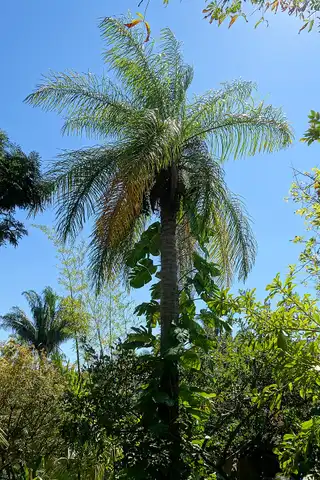
The shaggy, spiny palm of Brazilian and Paraguayan countryside.
- ADULT SIZE
- 10–15 m, the trunk often swollen and ringed with black spines.
- LEAVES
- Light, unruly pinnate fronds — hair in the wind.
- FRUIT
- Clusters of round yellow-brown fruits (the macaúba).
- IN PLAY
- Its unkempt crown over pastureland signs the Cerrado, Paraguay and northern Argentina — with the carandá it makes the Chaco pair.
- NATIVE
- Brazil · Colombia · Costa Rica · Dominican Republic · France · Guatemala · Mexico · Panama · Puerto Rico
Babassu palm
Attalea speciosa · Feather palm
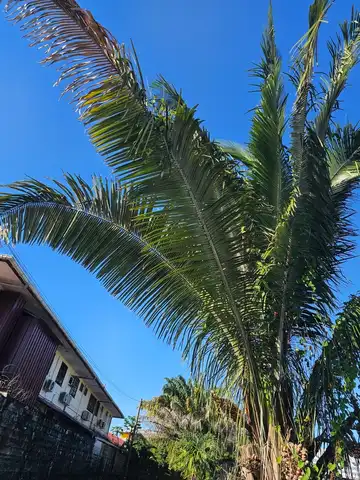
The babassu: whole forests of upright fronds in Brazil’s North-East.
- ADULT SIZE
- Up to 20–30 m, on a straight bare trunk.
- LEAVES
- Very long stiff pinnate fronds held UPRIGHT — the crown points at the sky.
- FRUIT
- Heavy bunches of brown oil-rich nuts.
- IN PLAY
- Dense stands to the horizon between Maranhão and Tocantins — the ‘babassu belt’ is a Brazilian regional marker on its own (babassu + macaúba = northern Tocantins).
- NATIVE
- Bolivia · Brazil
Açaí palm
Euterpe oleracea · Feather palm
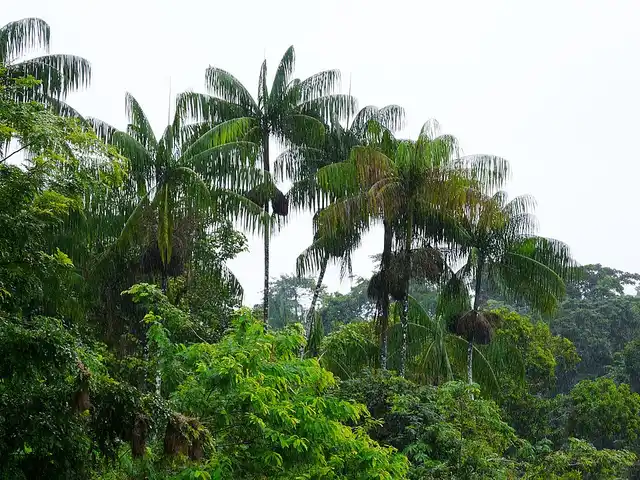
The açaí: clumps of slender stems along Amazonian waters.
- ADULT SIZE
- 15–25 m, in clumps of several very thin stems.
- LEAVES
- Fine fronds with hanging leaflets, as if snapped — the crown seems to drip.
- FRUIT
- Small dark-purple berries in tight sprays — the açaí.
- IN PLAY
- Its slender clumps by riverbanks and stilt villages say the Amazon estuary — Pará first of all.
- NATIVE
- Brazil · Colombia · Ecuador · France · Peru
Carnauba/Ceara palm
Copernicia prunifera · Fan palm
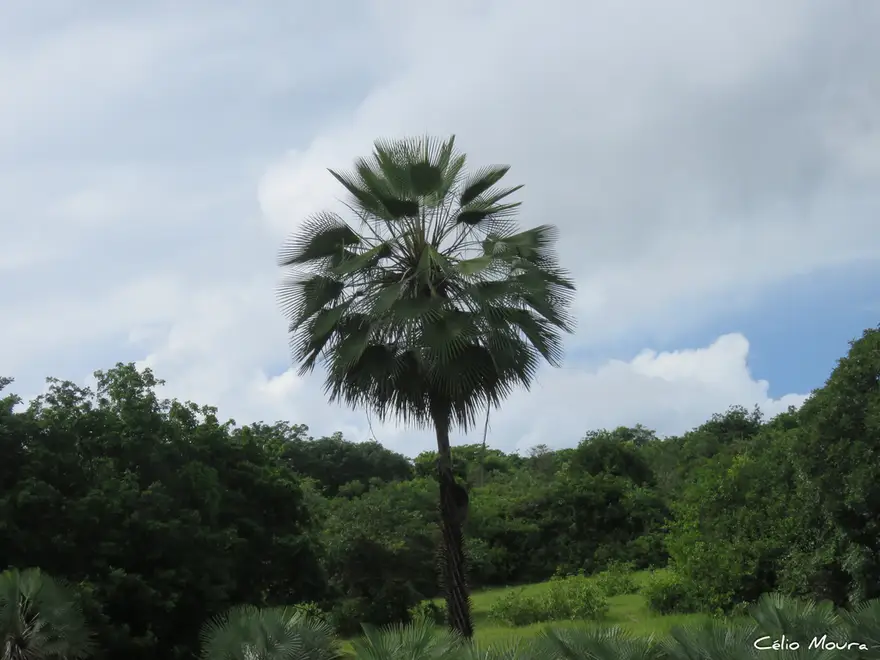
The carnauba, wax and fans of Ceará.
- ADULT SIZE
- 10–15 m, the lower trunk often clad in a spiral of old leaf bases.
- LEAVES
- Stiff waxy fans in a sparse rounded crown.
- IN PLAY
- Whole valleys of fans in the semi-arid sertão: Brazil’s North-East, Ceará and Piauí first.
- NATIVE
- Brazil
Toquilla palm
Carludovica palmata
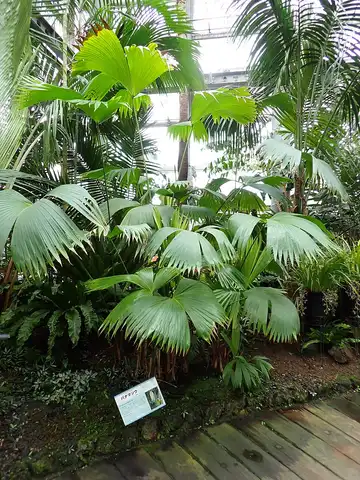
The trunkless palm-lookalike woven into ‘Panama’ hats.
- ADULT SIZE
- 2–4 m — fans rising straight from the ground, no trunk.
- LEAVES
- Pleated fans on long stalks, split into four lobes.
- IN PLAY
- Bunches of fans low on damp roadsides: Ecuador and Amazonian Peru — Montecristi-hat country.
- NATIVE
- Bolivia · Brazil · Colombia · Costa Rica · Ecuador · Guatemala · Mexico · Panama · Peru
Carandá palm
Copernicia alba · Fan palm
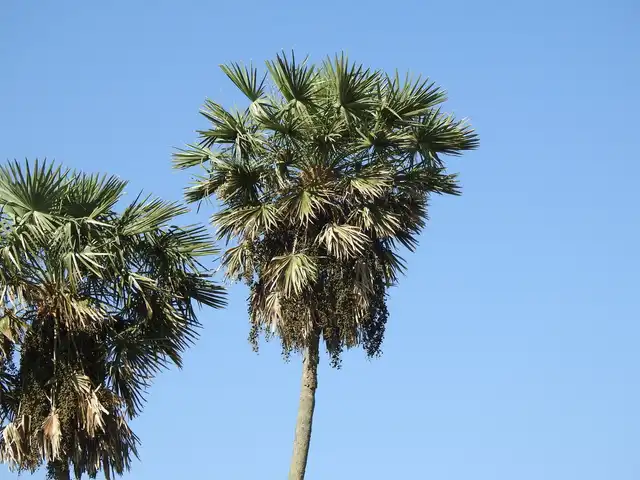
The carandá: floodable palm plains of the Chaco and Pantanal.
- ADULT SIZE
- Up to 20 m, on a thin straight greyish trunk.
- LEAVES
- Small stiff fans in a high sparse crown, dead fronds often hanging below.
- IN PLAY
- Thousands of thin trunks over grassy flood plains: Paraguay, the Pantanal, northern Argentina — the classic wet-Chaco horizon, into Mato Grosso do Sul.
- NATIVE
- Argentina · Bolivia · Brazil · Paraguay
Urucuri palm
Attalea phalerata · Feather palm
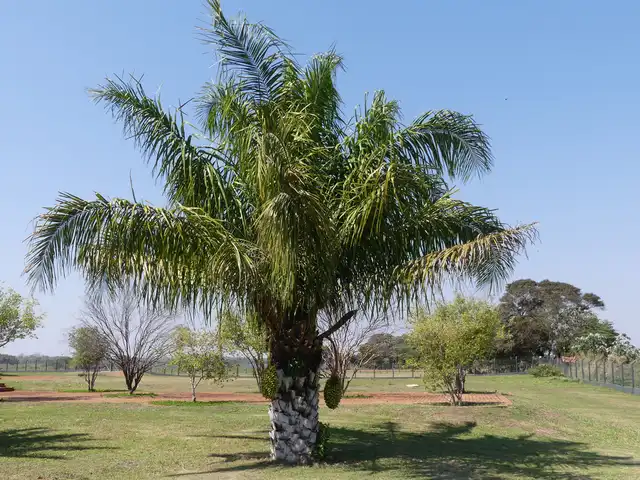
The urucuri, squat and bushy, the carandá’s companion in the Pantanal.
- ADULT SIZE
- Often low — a short thick trunk clad in old frond bases.
- LEAVES
- Long dense pinnate fronds, arching to the ground on young plants.
- IN PLAY
- The bush-palm of Bolivian and Pantanal roadsides: low, shaggy, often grouped in pastures.
- NATIVE
- Argentina · Bolivia · Brazil · Paraguay · Peru
Peach palm
Bactris gasipaes · Feather palm
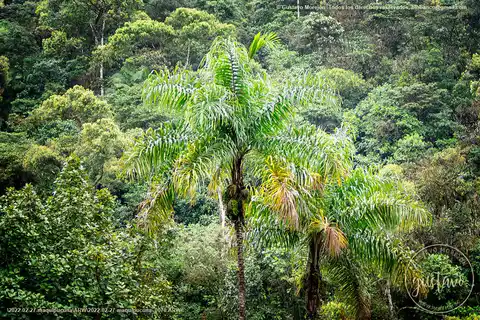
The peach palm of Amerindian gardens, its trunk ringed with spines.
- ADULT SIZE
- Up to 20 m, in clumps of slim stems ringed with black spines.
- FRUIT
- Clusters of orange-red fruits (the pejibaye), boiled and sold roadside.
- IN PLAY
- Planted by houses across Amazonia and Central America — a yard palm, not a forest one; Costa Rica sells its fruit at every crossroads.
- NATIVE
- Bolivia · Brazil · Colombia · Costa Rica · Ecuador · France · Panama · Peru
African palmyra palm
Borassus aethiopum · Fan palm
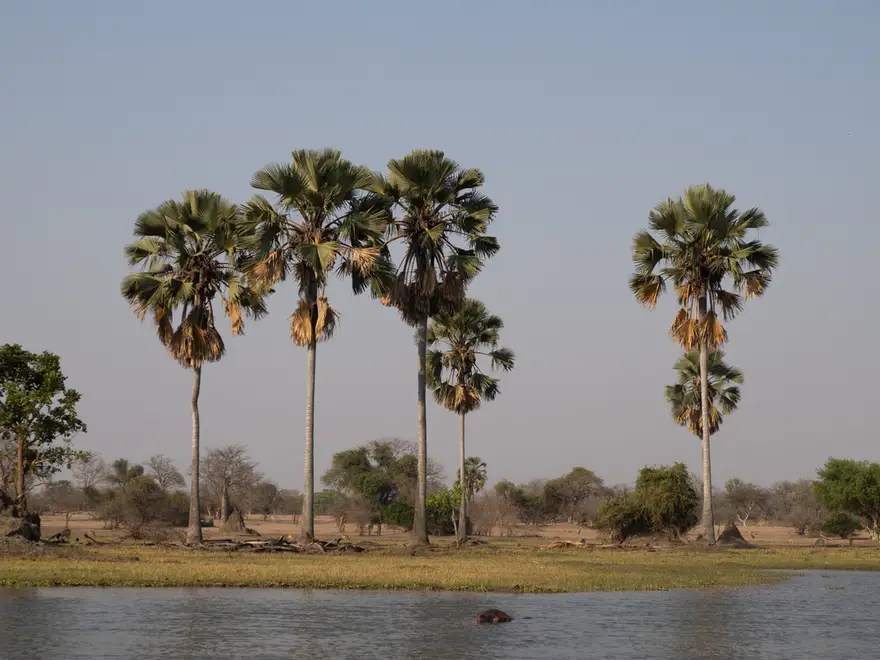
The African palmyra: the great fan of Africa’s savannas.
- ADULT SIZE
- Up to 25 m, the massive trunk often swollen above mid-height.
- LEAVES
- Large stiff fans in a rounded crown.
- FRUIT
- Large orange fruits in clusters, beloved of elephants.
- IN PLAY
- The trunk’s bulge is its signature: West and East African savannas, Senegal to Uganda — where its Palmyra cousin would say Asia.
- NATIVE
- Egypt · France · Ghana · Kenya · Madagascar · Nigeria · Rwanda · São Tomé and Príncipe · Senegal · South Africa · Uganda
West african palmyra palm
Borassus akeassii · Fan palm
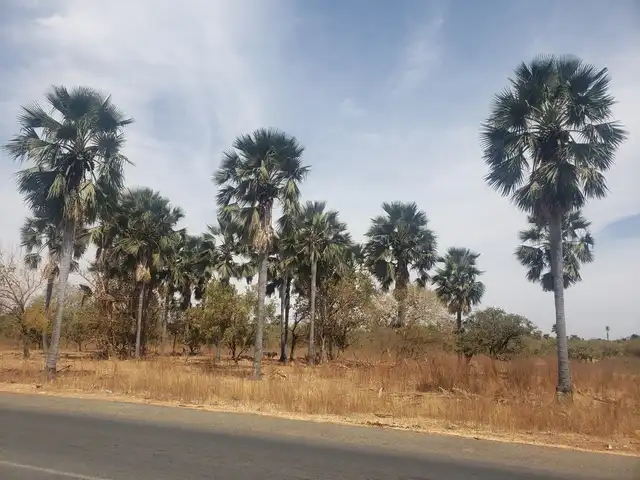
The western palmyra, Sahelian twin of the last.
- ADULT SIZE
- A tall fan palm, close to the African palmyra and long confused with it.
- IN PLAY
- THE Borassus of Burkina, Mali and Senegal — in game, no need to split it from its cousin: a palmyra in Sahelo-Sudanian country is enough to say West Africa.
- NATIVE
- Ghana · Nigeria · Senegal
Mazari palm
Nannorrhops ritchieana · Fan palm
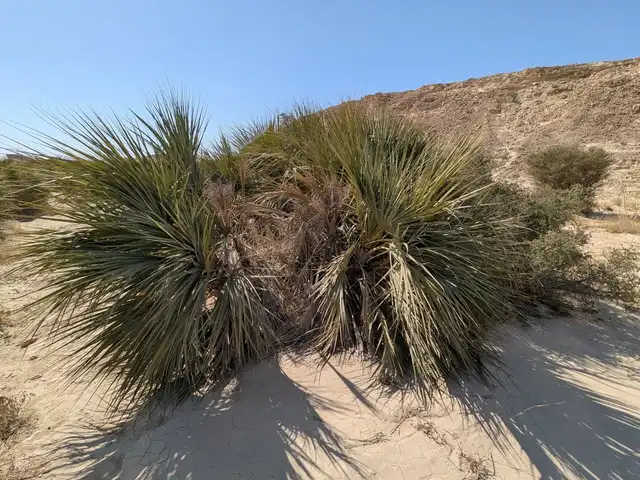
The mazari palm: blue-grey clumps in Afghan and Pakistani wadis.
- ADULT SIZE
- Shrubby, 1–5 m — rarely a true trunk.
- LEAVES
- Stiff blue-grey fans in ground-level clumps.
- IN PLAY
- The only palm of the dry mountains between Iran and Pakistan: fan clumps on beige rubble — rare, but unambiguous.
- NATIVE
- Oman · Qatar · United Arab Emirates
Maripa palm
Attalea maripa · Feather palm
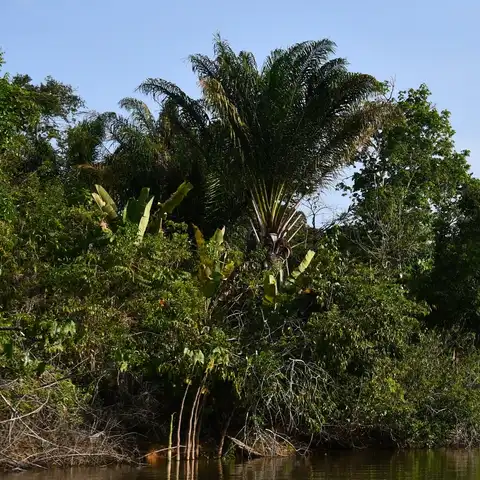
The maripa, tall plume of Guianan and Amazonian forest edges.
- ADULT SIZE
- Up to 20 m and more, on a straight bare trunk.
- LEAVES
- Long pinnate fronds with leaflets held in several planes.
- IN PLAY
- Left standing in clearings across the Guiana Shield and northern Brazil — an Attalea on red laterite leans Roraima and the Guianas.
- NATIVE
- Bolivia · Brazil · Colombia · Ecuador · France · Peru
Taraw palm
Livistona speciosa · Fan palm
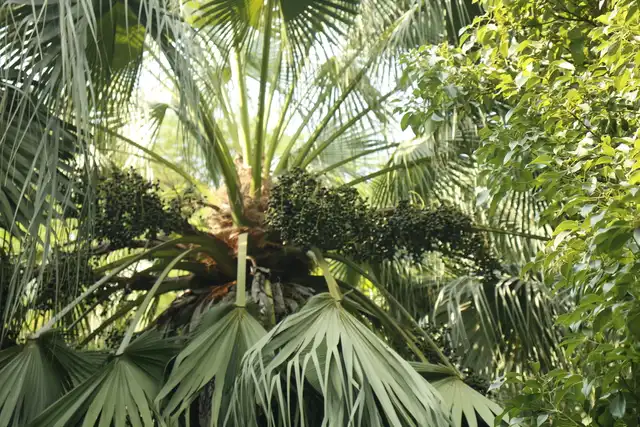
The taraw, fan palm of mainland South-East Asian hills.
- ADULT SIZE
- Up to 20–25 m, on a straight grey-streaked trunk.
- LEAVES
- Large fans with segments drooping in fine tips.
- IN PLAY
- Its fans over the open hill forests of Myanmar and Thailand — a wild Livistona on a hillside leans Indochina, not the islands.
- NATIVE
- Bangladesh · India · Laos · Malaysia · Thailand · Vietnam
Palma llanera
Copernicia tectorum · Fan palm
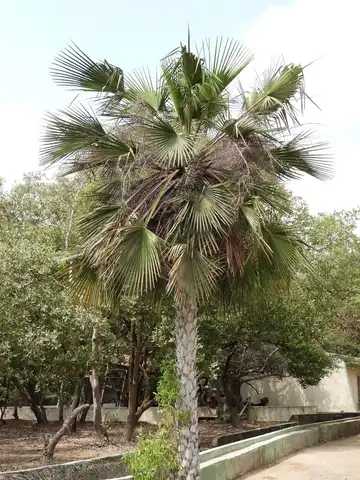
The palma llanera, fan of the Venezuelan plains.
- ADULT SIZE
- Up to 10–15 m, on a straight bare trunk.
- IN PLAY
- Scattered fans over the floodable llanos: Venezuela and eastern Colombia — the Caribbean counterpart of the Chaco’s carandá.
- NATIVE
- Brazil · Colombia
Canary Island date palm
Phoenix canariensis · Feather palm
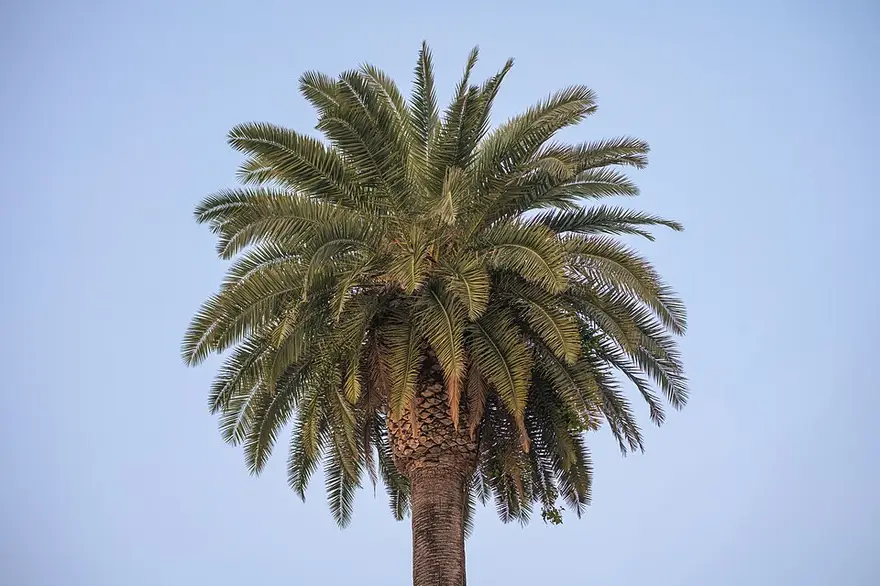
The Canary date palm: the giant pineapple of southern promenades.
- ADULT SIZE
- 10–20 m, on a VERY thick trunk for a Phoenix.
- LEAVES
- A huge dense crown of arching pinnate fronds — far fuller than the true date palm.
- BARK
- Trunk carved into regular diamonds by the trimmed frond bases — the ‘pineapple’.
- IN PLAY
- The stately palm of seafronts: the Riviera, Spain, the Canaries, but also California and Australia. Its opulent crown tells it from the true date palm, thinner and often clumping.
- NATIVE
- Spain
Jelly palm
Butia yatay · Feather palm
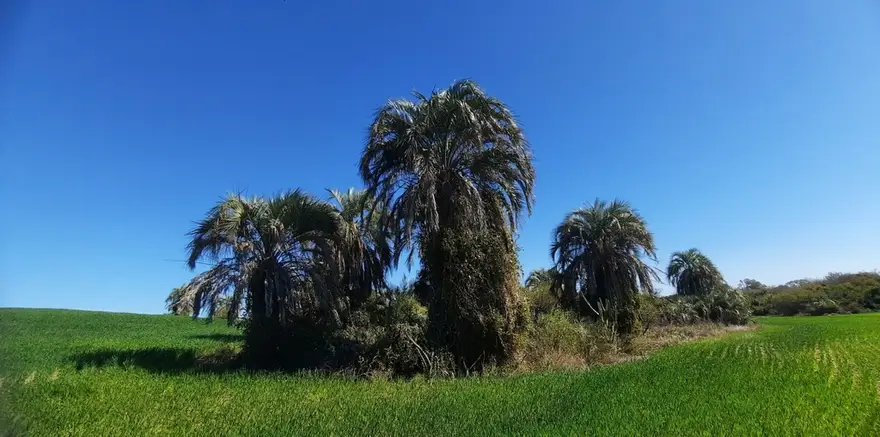
The jelly palm with recurved blue-grey fronds, treasure of Argentina’s Palmar.
- ADULT SIZE
- 8–12 m, on a thick trunk clad in old leaf bases.
- LEAVES
- Blue-grey pinnate fronds strongly RECURVED towards the ground — a drooping look.
- IN PLAY
- Savannas of blue-tinged palms between Entre Ríos and Uruguay — El Palmar park is its kingdom, a landscape found nowhere else.
- NATIVE
- Argentina · Brazil · Uruguay
Cabbage palmetto
Sabal palmetto · Fan palm
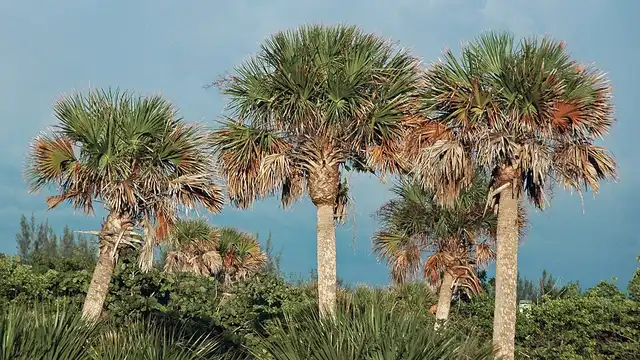
The cabbage palmetto: state fan of Florida and the Carolinas.
- ADULT SIZE
- Up to 20 m, the straight trunk often crosshatched with old leaf bases.
- LEAVES
- Costapalmate fans with drooping, thread-hung segments.
- IN PLAY
- The fan of the American South-East’s verges: Florida first, up the coast to the Carolinas — an interstate lined with pines AND palmettos says the US South-East, not California.
- NATIVE
- United States of America
Fishtail palm
Caryota · Feather palm
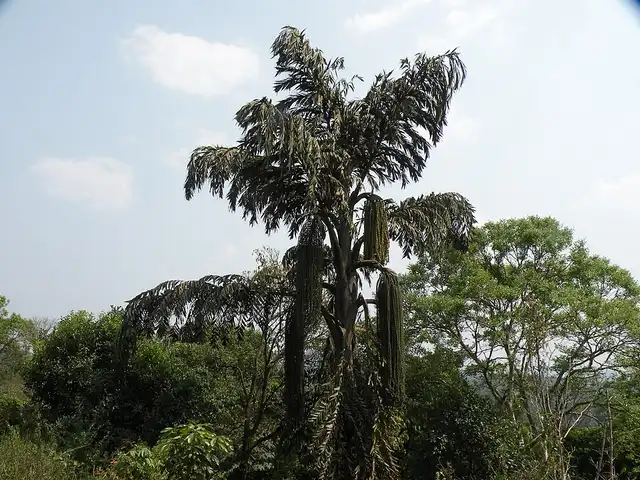
The fishtail palm — the only one with ragged, fin-shaped leaflets.
- ADULT SIZE
- 10–30 m depending on species, solitary or clumping.
- LEAVES
- Leaves TWICE pinnate — unique among palms — with fishtail-shaped leaflets.
- IN PLAY
- The ‘chopped’ texture of its crown reads at a glance: South and South-East Asia, India to the Philippines, often planted in tropical towns.
- NATIVE
- Australia · Bangladesh · Bhutan · Cambodia · India · Indonesia · Laos · Malaysia · Philippines · Sri Lanka · Thailand · Vietnam
Sources and licences
Govaerts, R. et al. — World Checklist of Vascular Plants (WCVP), Royal Botanic Gardens, Kew. http://sftp.kew.org/pub/data-repositories/WCVP/ — CC BY 4.0. Aires par pays botanique (WGSRPD niveau 3).
Sources: Acrocomia aculeata · Areca catechu · Attalea butyracea · Attalea maripa · Attalea phalerata · Attalea speciosa · Bactris gasipaes · Borassus aethiopum · Borassus akeassii · Borassus flabellifer · Butia yatay · Carludovica palmata · Caryota · Cocos nucifera · Copernicia alba · Copernicia prunifera · Copernicia tectorum · Elaeis guineensis · Euterpe oleracea · Hyphaene petersiana · Livistona speciosa · Mauritia flexuosa · Nannorrhops · Phoenix canariensis · Phoenix dactylifera · Phoenix sylvestris · Sabal mauritiiformis · Sabal palmetto · Washingtonia filifera var. robusta · Palmier à huile · Phoenix sylvestris · Repeated-tapping-of-Phoenix-sylvestris-in-Bangladesh-leaves-zigzag-scars-on-the-trunks fig6 290390999