Temperate broadleaves
Temperate broadleaves are the backdrop of Europe, the eastern United States and East Asia. On their own they say little; the species does the talking — holm oak and olive for the Mediterranean, birch for the north, planted eucalyptus for Iberia or South America. Mind the seasons: the image may have been taken with the leaves down.
Olive tree
Olea europaea · Rounded broadleaf
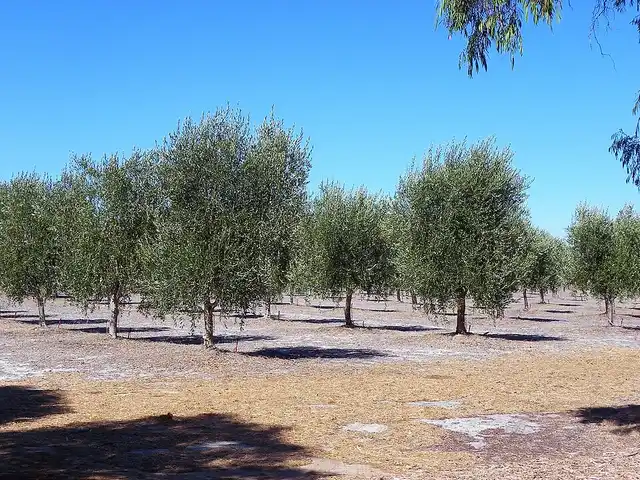
The tree that draws the edge of the Mediterranean.
- ADULT SIZE
- Around 10 m tall.
- LEAVES
- Oblong, grey-green above and whitish below; the tree is evergreen.
- BARK
- Grey, on a gnarled and twisted trunk.
- FRUIT
- A small drupe 1–2.5 cm long when ripe.
- IN PLAY
- An olive grove in rows on worked red soil is one of the surest signs of the Mediterranean basin. Cross it with the Csa layer: where the olive stops, the summer stops being dry.
- NATIVE
- Albania · Austria · Bosnia and Herzegovina · Botswana · Bulgaria · Croatia · Egypt · Eswatini · France · Greece · India · Israel · Italy · Jordan · Kenya · Kosovo · Lesotho · Montenegro · Namibia · Nepal · North Macedonia · Oman · Portugal · Rwanda · Serbia · Slovenia · South Africa · Spain · Tunisia · Turkey · Uganda
Apple tree
Malus domestica · Rounded broadleaf
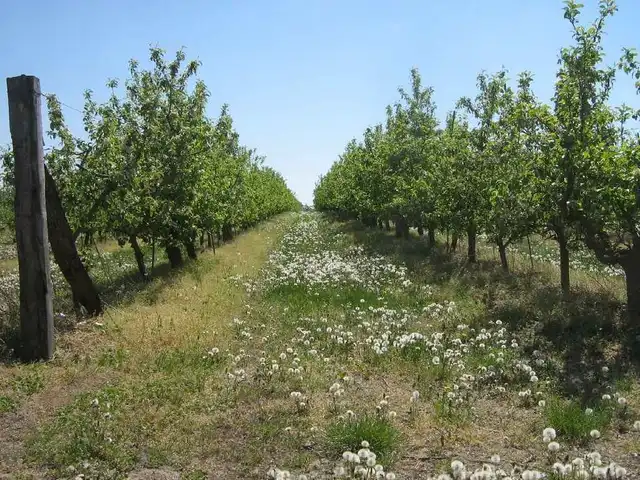
The apple tree: low orchards in rows, nets and trellises.
- ADULT SIZE
- 5–10 m free-standing; kept low in commercial orchards, often trellised.
- FRUIT
- The apple — visible from afar by late summer.
- IN PLAY
- Low rows under hail nets say Normandy, the Loire, South Tyrol, Poland — Europe’s top grower — and Yakima in the United States.
- NATIVE
- Kazakhstan · Kyrgyzstan · Russia
Silver birch
Betula pendula · Rounded broadleaf
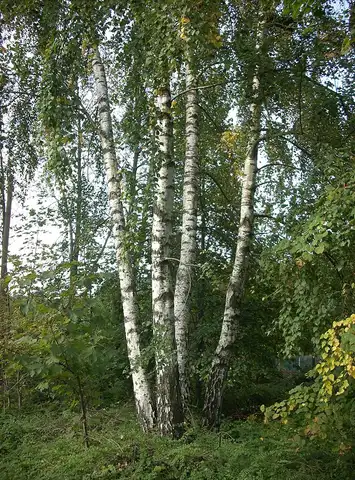
The white trunk of northern Europe, all the way to Siberia.
- ADULT SIZE
- 15–25 m tall, exceptionally 31 m; slender trunk.
- LEAVES
- 3–7 cm, triangular, with a wedge-shaped base and double-toothed margins.
- BARK
- White, peeling in flakes; dark and rugged at the foot of old trees.
- FRUIT
- Pendulous cylindrical catkins 2–4 cm long.
- IN PLAY
- White trunks in masses by the road mean north and east: Scandinavia, the Baltics, Russia — it is Finland’s national tree. On its own in a garden it says little: it is planted everywhere.
- NATIVE
- Albania · Argentina · Austria · Belgium · Bosnia and Herzegovina · Bulgaria · Canada · Croatia · Czech Republic · Denmark · Estonia · Finland · France · Georgia · Germany · Greece · Hungary · India · Ireland · Italy · Japan · Kazakhstan · Kosovo · Kyrgyzstan · Latvia · Lithuania · Luxembourg · Mongolia · Montenegro · Netherlands · North Macedonia · Norway · Poland · Portugal · Romania · Russia · Serbia · Slovakia · Slovenia · South Korea · Spain · Sweden · Switzerland · Turkey · Ukraine · United Kingdom · United States of America
Downy birch
Betula pubescens · Rounded broadleaf
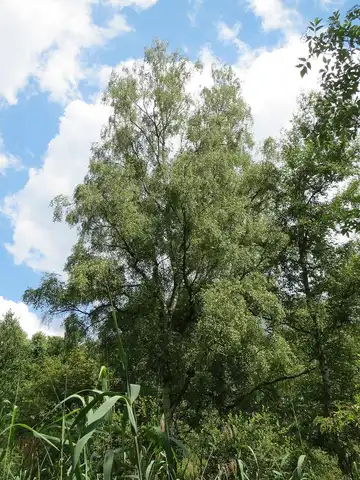
The birch of bogs and the far North, all the way to Iceland.
- ADULT SIZE
- 10–20 m, often far less up north — shrubby in Iceland.
- LEAVES
- Downy twigs, rounded leaves — less weeping than its twin.
- BARK
- White to grey-brown, duller than silver birch, without bold black diamonds.
- IN PLAY
- THE birch of soaked ground and Arctic margins: Iceland’s only forest-forming tree — a twisted birch grove on volcanic heath is this one.
- NATIVE
- Austria · Belgium · Bosnia and Herzegovina · Bulgaria · Canada · Croatia · Czech Republic · Denmark · Estonia · Finland · France · Georgia · Germany · Greenland · Hungary · Iceland · Ireland · Italy · Kazakhstan · Kosovo · Latvia · Lithuania · Luxembourg · Montenegro · Netherlands · North Macedonia · Norway · Poland · Portugal · Romania · Russia · Serbia · Slovakia · Slovenia · Spain · Sweden · Switzerland · Turkey · Ukraine · United Kingdom
Black locust
Robinia pseudoacacia · Rounded broadleaf
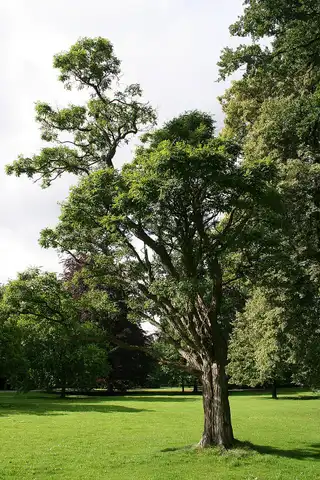
The black locust: the naturalised American of every European verge.
- ADULT SIZE
- 20–30 m, with a light, irregular crown.
- LEAVES
- Compound leaves of oval leaflets, thorny twigs — a light acacia-like foliage.
- BARK
- Grey-brown, deeply furrowed in criss-cross ridges.
- FRUIT
- Flat brown pods; fragrant white flower sprays in May.
- IN PLAY
- The roadside and railway coppices of France, Hungary (its second home) and China — too common to pin a spot, but its braided bark is known everywhere.
- NATIVE
- United States of America
Evergreen oak
Quercus ilex · Rounded broadleaf
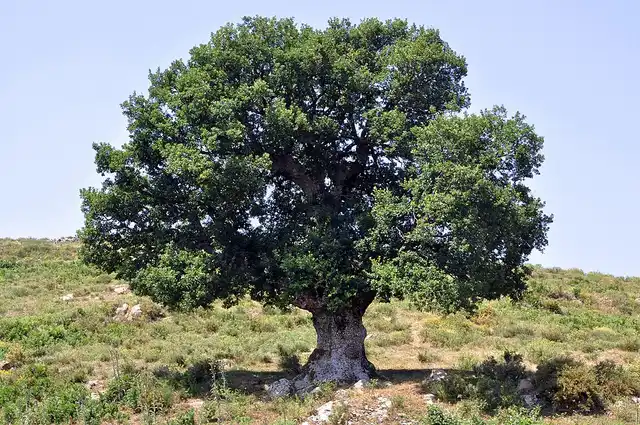
The evergreen oak of the south, a dark dense ball.
- ADULT SIZE
- 21–28 m in favourable places.
- LEAVES
- Evergreen and very variable: narrowly oval to ovate-lanceolate, 4–8 cm long, dark glossy green above, grey to tawny beneath; the margin is entire on mature trees and often spiny-toothed on young ones.
- FRUIT
- Acorns one to three together on a short downy stalk, ripening in the first season, 12–20 mm long.
- IN PLAY
- This is the textbook case of the guide: the holm oak holds the dry south, the pedunculate oak damp France and the north. An oak with small, leathery, persistent leaves over garrigue is not an oak of the Paris basin.
- NATIVE
- Albania · Austria · Bosnia and Herzegovina · Croatia · Czech Republic · France · Greece · Italy · Kosovo · Montenegro · North Macedonia · Poland · Portugal · Serbia · Slovakia · Slovenia · Spain · Switzerland · Tunisia · Turkey
Pedunculate oak
Quercus robur · Rounded broadleaf
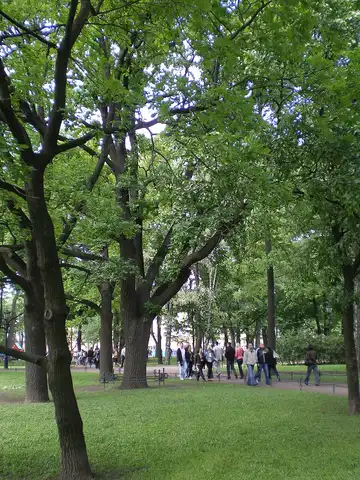
The pedunculate oak: the great oak of Atlantic hedgerow country.
- ADULT SIZE
- 25–40 m, with a broad, gnarled crown in age.
- LEAVES
- Lobed leaves nearly stalkless; it is the ACORNS that hang on a long stalk.
- BARK
- Grey-brown, fissured into small regular plates.
- IN PLAY
- The tree of hedgerows and meadows on the Atlantic side — Brittany, Normandy, England, and east to the Urals. Against the holm oak: this one says ocean, the other Mediterranean — our benchmark pair.
- NATIVE
- Albania · Austria · Belgium · Bosnia and Herzegovina · Bulgaria · Croatia · Czech Republic · Denmark · Estonia · Finland · France · Georgia · Germany · Greece · Hungary · Ireland · Italy · Kazakhstan · Kosovo · Latvia · Lithuania · Luxembourg · Montenegro · Netherlands · North Macedonia · Norway · Poland · Portugal · Romania · Russia · Serbia · Slovakia · Slovenia · Spain · Sweden · Switzerland · Turkey · Ukraine · United Kingdom
Cork oak
Quercus suber · Rounded broadleaf
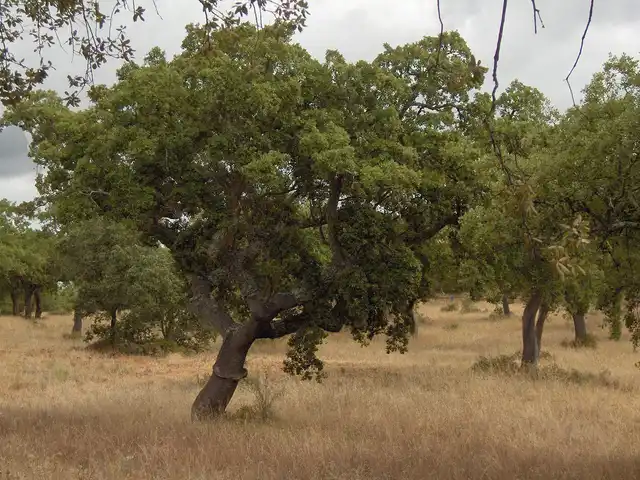
The oak that gets stripped: a russet trunk under peeled bark.
- ADULT SIZE
- 10–15 m on average, rarely 25; the trees can live over 400 years.
- LEAVES
- Evergreen, 2.5–10 cm long by 1.2–6.5 cm wide, round to ovate-lanceolate.
- BARK
- The cork layer is 3–5 cm thick and is harvested every nine to twelve years; a freshly stripped trunk looks reddish brown, then much darker.
- FRUIT
- Acorns 2–4.5 cm long by 1–1.8 cm wide, the casing bare, smooth and shiny reddish brown.
- IN PLAY
- The clue is not the tree but the HARVEST: a trunk stripped up to two metres, russet, with a painted number, means Portugal, Extremadura, Andalusia, Sardinia or Corsica. Without that mark a cork oak looks like a holm oak.
- NATIVE
- France · Italy · Portugal · Spain · Tunisia
European beech
Fagus sylvatica · Rounded broadleaf
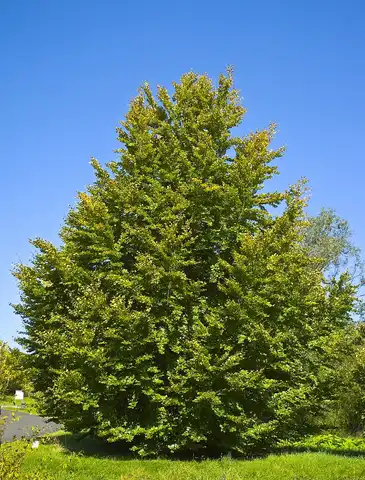
The beech: smooth grey boles and bare floors of cathedral woods.
- ADULT SIZE
- 25–40 m, straight-boled, densely canopied.
- LEAVES
- Entire glossy oval leaves, copper in autumn and often held through winter on young trees.
- BARK
- GREY AND SMOOTH into old age — elephant skin.
- FRUIT
- Beechnuts, paired in a bristly husk.
- IN PLAY
- A stand of grey columns over bare russet ground: the hill belt of western and central Europe — Basque country to the Carpathians. It shuns the dry Mediterranean and deep continental cold.
- NATIVE
- Albania · Austria · Belgium · Bosnia and Herzegovina · Bulgaria · Croatia · Czech Republic · Denmark · Estonia · France · Germany · Greece · Hungary · Italy · Kosovo · Latvia · Lithuania · Luxembourg · Montenegro · Netherlands · North Macedonia · Norway · Poland · Romania · Russia · Serbia · Slovakia · Slovenia · Spain · Sweden · Switzerland · Turkey · Ukraine · United Kingdom
London plane
Platanus × hispanica · Rounded broadleaf
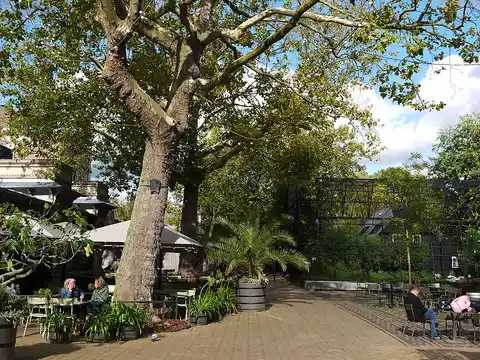
The mottled-trunk street tree, from London to Sydney.
- ADULT SIZE
- 20–40 m tall, exceptionally 50 m.
- LEAVES
- Palmately lobed like a maple’s, 10–20 cm long.
- BARK
- Pale grey-green, smooth, exfoliating in patches.
- FRUIT
- Balls 2–3 cm across, most often two per hanging stalk.
- IN PLAY
- A garden hybrid, native nowhere: it says “temperate town”, not the country. Plane-lined roads in southern Europe, streets of London or New York, Australian avenues — it is scenery, not a clue.
Northern red oak
Quercus rubra · Rounded broadleaf
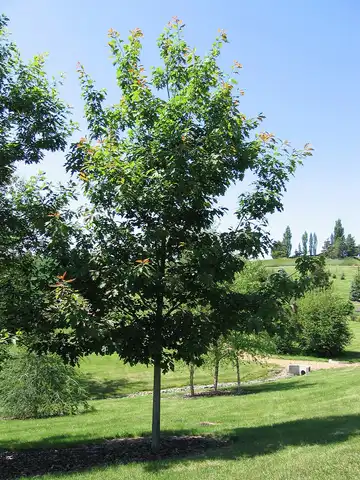
The northern red oak: pointed lobes say America.
- ADULT SIZE
- 20–30 m, with a broad even crown.
- LEAVES
- Lobes tipped with BRISTLE-POINTS — Europe’s oaks have them rounded — and a deep autumn red.
- BARK
- Grey, with long smooth shiny stripes between the fissures.
- IN PLAY
- Flag-bearer of the American North-East’s hardwoods: New England, the Appalachians, Ontario. In game it stands for the WHOLE troop of pointy-leaved American oaks.
- NATIVE
- Canada · United States of America
Hungarian oak
Quercus frainetto · Rounded broadleaf
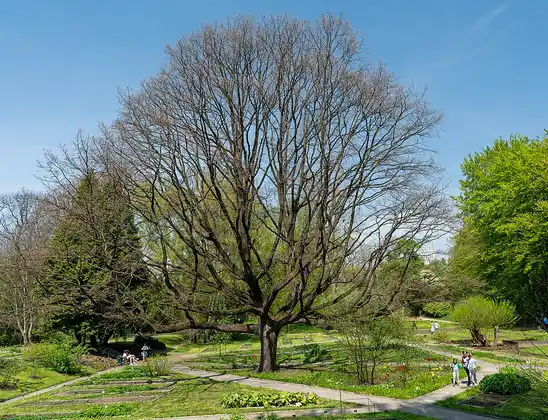
The Hungarian oak: the great oak of the Balkans.
- ADULT SIZE
- 20–35 m, with a broad dense crown.
- LEAVES
- Large leaves very deeply lobed, almost to the midrib.
- IN PLAY
- The open oak woods of Serbia, Bulgaria, northern Greece and north-west Turkey — when the country looks western European but the plates are Cyrillic, it is often this oak.
- NATIVE
- Albania · Austria · Bosnia and Herzegovina · Bulgaria · Croatia · Greece · Hungary · Italy · Kosovo · Montenegro · North Macedonia · Romania · Serbia · Slovenia · Turkey · Ukraine
Tree of heaven
Ailanthus altissima · Rounded broadleaf
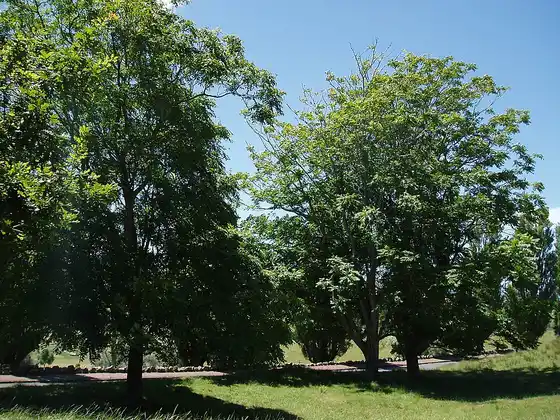
The tree of heaven: the wasteland tree, sprouting wherever it was forgotten.
- ADULT SIZE
- 15–25 m, very fast-growing, suckering everywhere.
- LEAVES
- Huge compound leaves (to 90 cm) of many leaflets — a giant sumac or ash look.
- FRUIT
- Showy sprays of reddish winged seeds in late summer.
- IN PLAY
- Chinese in origin, it colonises track sides and vacant lots across southern Europe and American cities — it says ‘urban wasteland’, rarely a country.
- NATIVE
- India · Taiwan
Blue gum
Eucalyptus globulus · Eucalypt
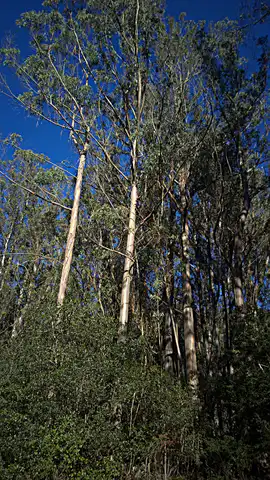
The blue gum: the eucalypt of Iberian plantations.
- ADULT SIZE
- 30–55 m — among the tallest planted trees in Europe.
- LEAVES
- Juvenile leaves round, GLAUCOUS BLUE, opposite; adult ones sickle-shaped, hanging — often both on one tree.
- BARK
- Sheds in long ribbons, the smooth trunk cream to bluish.
- IN PLAY
- Native to Tasmania and Victoria, but its card in game is Iberia: the hills of northern Portugal and Galicia are blanketed with it. A European eucalypt is nearly always this one.
- NATIVE
- Australia
River red gum
Eucalyptus camaldulensis · Eucalypt
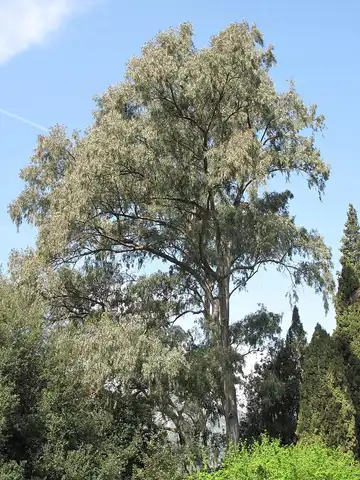
The river red gum: tree of inland Australia’s rivers.
- ADULT SIZE
- 20–45 m, its massive trunk often leaning over water.
- BARK
- Smooth, in cream, grey and rust patches — mottled like pale camouflage.
- IN PLAY
- The pale tree-line tracing every watercourse in the bush: along a dry creek from Victoria to Queensland, it is this one. Also planted across the world’s drylands.
- NATIVE
- Australia
Paper birch
Betula papyrifera · Rounded broadleaf
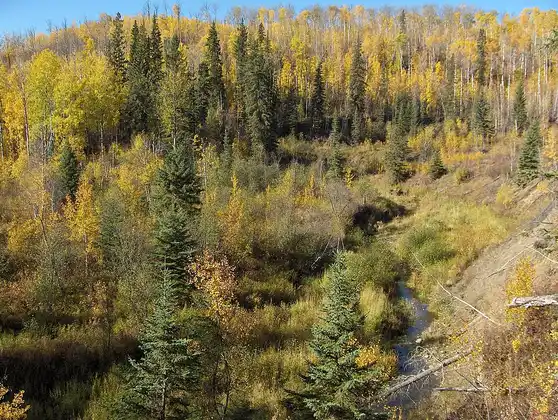
The paper birch: Canada’s white trunk.
- ADULT SIZE
- 15–25 m, often in clumps of several trunks.
- BARK
- Creamy white, peeling in broad horizontal PAPER SHEETS — shaggier than Europe’s birch.
- IN PLAY
- The birch of Canadian roads, Ontario to Newfoundland and up to Alaska — mixed with fir and spruce it makes the eastern boreal forest. Its European cousin wears black diamonds; this one peels like paper.
- NATIVE
- Canada · United States of America
Quaking aspen
Populus tremuloides · Rounded broadleaf
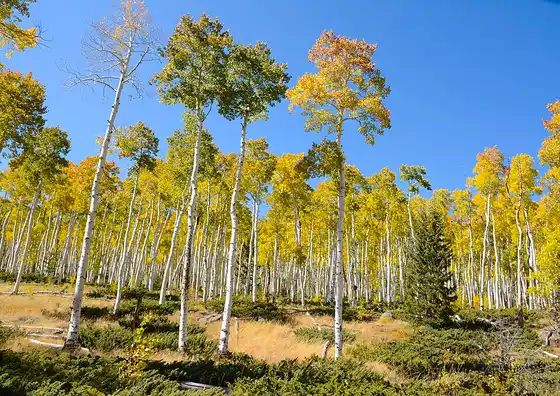
The quaking aspen: pale trunks and trembling leaves, in whole colonies.
- ADULT SIZE
- 15–25 m, in clonal stands — whole groves of a single organism.
- LEAVES
- Small round leaves on flattened stalks — they quiver at a breath; blazing gold in autumn.
- BARK
- Smooth, greenish-white to cream, marked with black scars — without the birch’s paper ribbons.
- IN PLAY
- North America’s most widespread tree: the Canadian Prairie parkland (Manitoba, Saskatchewan), Ontario, and the Rockies’ golden slopes in autumn. Smooth bark = aspen, papery bark = birch.
- NATIVE
- Canada · Mexico · United States of America
Eucalyptus
Eucalyptus · Eucalypt
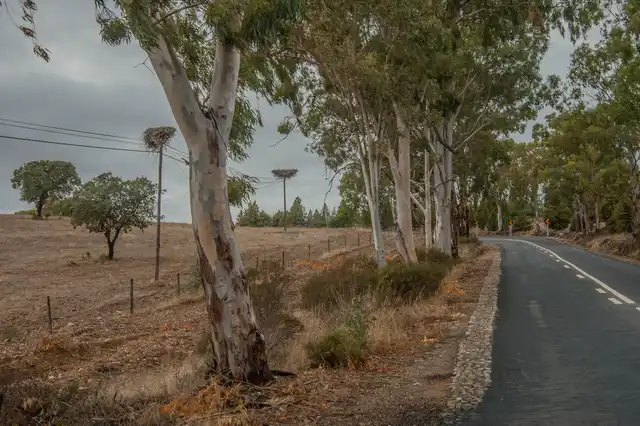
Seven hundred Australian species, planted on five continents.
- ADULT SIZE
- From shrub to the tallest broadleaf on earth: mallees rarely pass 10 m, and the tallest measured Eucalyptus regnans stands 100.5 m.
- LEAVES
- Juvenile and adult leaves differ — opposite and glaucous at first, lanceolate and alternate later. They hang downwards, so the shade is thin; all of them carry oil glands.
- BARK
- About half the species shed it, in large slabs, ribbons or flakes, exposing fresh bark beneath; the others keep it — stringybark, ironbark, box.
- FRUIT
- A woody, roughly cone-shaped capsule opening by valves at the tip; the seeds are waxy rods about 1 mm long.
- IN PLAY
- Native, it says Australia. Introduced, it says plantation — Portugal, Galicia, California, Ethiopia, Brazil, South Africa — and the solid-versus-pale distinction on this map is exactly the question to ask. A eucalyptus row in Portugal is not an Australian clue.
- NATIVE
- Australia · Indonesia · Philippines
Walnut trees
Juglans · Rounded broadleaf
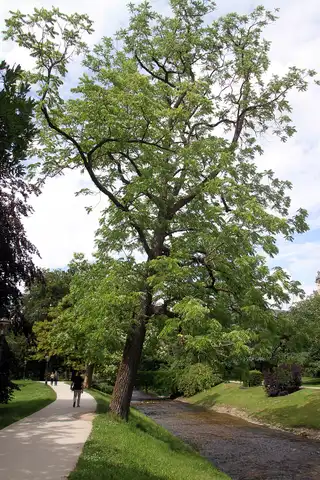
The lone walnut in the middle of a field — a France reflex.
- ADULT SIZE
- 25–35 m in open ground, with a broad rounded crown.
- LEAVES
- Large compound leaves with 5–9 smooth oval leaflets.
- BARK
- Smooth and grey when young, later fissured into broad pale ridges.
- FRUIT
- The walnut, in a green husk that blackens on the ground.
- IN PLAY
- A big round broadleaf standing ALONE mid-plot, or in tidy orchards: Périgord, Grenoble, but also Anatolia and Kashmir. The boundary-tree of rural France.
- NATIVE
- Argentina · Bhutan · Bolivia · Brazil · Canada · Colombia · Costa Rica · Dominican Republic · Ecuador · France · Georgia · Guatemala · India · Israel · Italy · Japan · Jordan · Lebanon · Mexico · Peru · Puerto Rico · Russia · South Korea · Spain · Taiwan · Thailand · Turkey · United States of America
Poplars
Populus · Columnar conifer
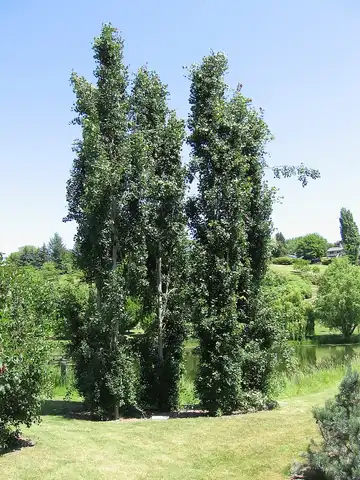
Poplar screens and avenues — the punctuation of the plains.
- ADULT SIZE
- 20–30 m and more, very fast-growing.
- LEAVES
- Triangular to oval leaves, trembling in the wind, often pale beneath.
- BARK
- Pale and smooth when young (white in some), blackly fissured with age.
- FRUIT
- Capsules shedding white fluff — the ‘snow’ of June.
- IN PLAY
- The strict column of the Lombardy poplar lines roads in the Po plain and France; gridded plantations say river valleys; white-barked aspens carpet the cold North to Canada.
- NATIVE
- Albania · Austria · Belgium · Bhutan · Bosnia and Herzegovina · Bulgaria · Canada · Croatia · Czech Republic · Denmark · Estonia · Finland · France · Georgia · Germany · Greece · Hungary · India · Ireland · Israel · Italy · Japan · Jordan · Kazakhstan · Kenya · Kosovo · Kyrgyzstan · Latvia · Lebanon · Lithuania · Luxembourg · Mexico · Mongolia · Montenegro · Nepal · Netherlands · North Macedonia · Norway · Poland · Portugal · Romania · Russia · Serbia · Slovakia · Slovenia · South Korea · Spain · Sweden · Switzerland · Thailand · Tunisia · Turkey · Ukraine · United Kingdom · United States of America
Willows
Salix · Rounded broadleaf
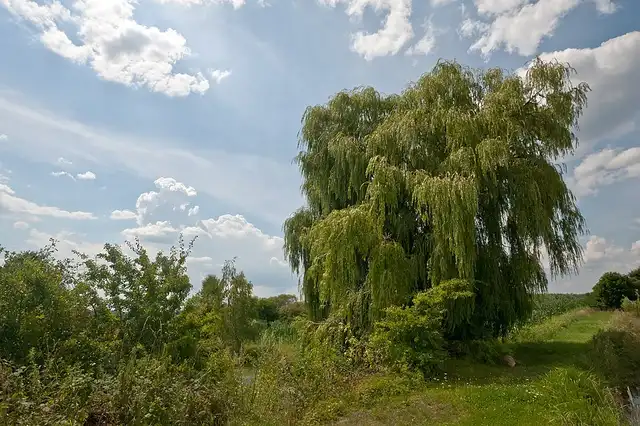
The willows: water is never far — and the pollard says hedgerow country.
- LEAVES
- Narrow lance-shaped leaves, often silvery beneath.
- IN PLAY
- A row of stubby trunks with mop-heads — POLLARDED willows — along a ditch: Flanders, Normandy, the Netherlands. The weeping willow adorns ponds worldwide and locates nothing.
- NATIVE
- Albania · Argentina · Austria · Bangladesh · Belgium · Bhutan · Bolivia · Bosnia and Herzegovina · Botswana · Brazil · Bulgaria · Cambodia · Canada · Chile · Colombia · Costa Rica · Croatia · Czech Republic · Denmark · Ecuador · Egypt · Estonia · Eswatini · Faroe Islands · Finland · France · Georgia · Germany · Ghana · Greece · Greenland · Guatemala · Hungary · Iceland · India · Indonesia · Ireland · Israel · Italy · Japan · Jordan · Kazakhstan · Kenya · Kosovo · Kyrgyzstan · Laos · Latvia · Lebanon · Lesotho · Lithuania · Luxembourg · Malaysia · Mexico · Mongolia · Montenegro · Namibia · Nepal · Netherlands · North Macedonia · Norway · Oman · Panama · Paraguay · Peru · Philippines · Poland · Portugal · Romania · Russia · Senegal · Serbia · Slovakia · Slovenia · South Africa · South Korea · Spain · Sweden · Switzerland · Taiwan · Thailand · Tunisia · Turkey · Uganda · Ukraine · United Kingdom · United States of America · Uruguay · Vietnam
Larch
Larix · Columnar conifer
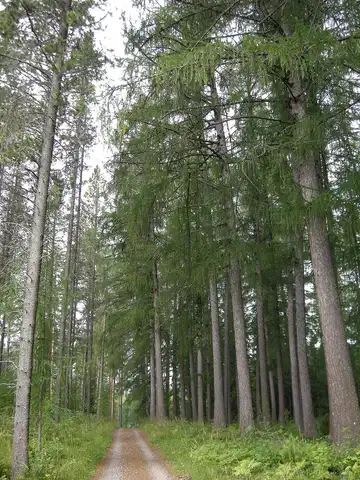
The larches: the only conifers that undress for winter.
- LEAVES
- Very fine needles in rosettes, fresh green in spring, GOLD in autumn, gone in winter.
- FRUIT
- Small upright cones that sit on the twigs for years.
- IN PLAY
- Slopes of gold in October in the Alps; endless open forest in Siberia — the Dahurian larch is the world’s northernmost tree. A ‘dead conifer’ in a Russian winter is a living larch.
- NATIVE
- Austria · Bhutan · Bosnia and Herzegovina · Bulgaria · Canada · Croatia · Czech Republic · France · Germany · Hungary · India · Italy · Japan · Kazakhstan · Kosovo · Mongolia · Montenegro · Nepal · North Macedonia · Poland · Romania · Russia · Serbia · Slovakia · Slovenia · South Korea · Switzerland · Thailand · Ukraine · United States of America
Hickories
Carya · Rounded broadleaf
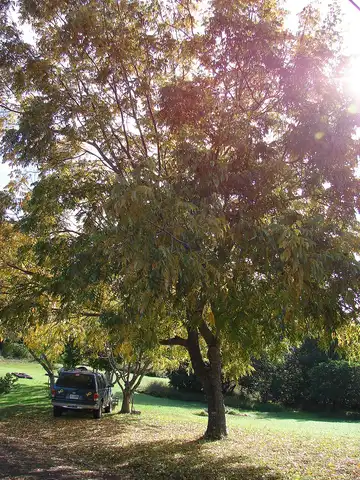
The hickories: America’s walnuts, hickory to pecan.
- LEAVES
- Large compound leaves of 5–9 leaflets, slimmer than walnut’s.
- BARK
- Often in long peeling strips (the shagbark).
- FRUIT
- Nuts in a husk splitting into four — the pecan in the cultivated one.
- IN PLAY
- A pillar of the oak-hickory forests of the US North-East quarter; tidy pecan orchards, meanwhile, say Georgia and Texas.
- NATIVE
- Bhutan · Canada · India · Laos · Mexico · Thailand · United States of America · Vietnam
Sources and licences
Govaerts, R. et al. — World Checklist of Vascular Plants (WCVP), Royal Botanic Gardens, Kew. http://sftp.kew.org/pub/data-repositories/WCVP/ — CC BY 4.0. Aires par pays botanique (WGSRPD niveau 3).
Sources: Ailanthus altissima · Apple · Betula papyrifera · Betula pendula · Betula pubescens · Eucalyptus · Eucalyptus camaldulensis · Eucalyptus globulus · Fagus sylvatica · Hickory · Juglans regia · Larch · London plane · Olive · Populus · Populus tremuloides · Quercus frainetto · Quercus ilex · Quercus robur · Quercus rubra · Quercus suber · Robinia pseudoacacia · Willow