Conifers & allies
Conifers hold cold climates and mountains, but also plantations. A dark, continuous forest suggests taiga or the Rockies; pines in ruler-straight rows, a plantation — New Zealand, Chile, southern Brazil, the Landes. The silhouette settles it fast: cypress flame, pine parasol, fir tiers.
Maritime pine
Pinus pinaster · Candelabra conifer
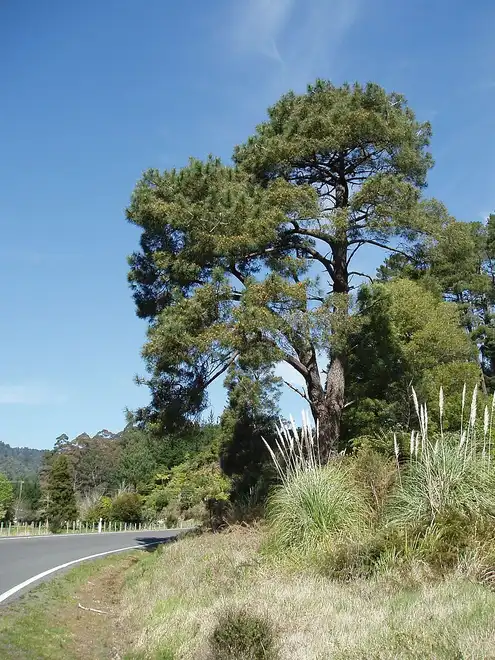
The pine of the Landes, with red bark and the longest needles.
- ADULT SIZE
- 20–35 m tall, exceptionally 41 m.
- LEAVES
- Needles in pairs, 10–25 cm, very stout: the longest of all European pines.
- BARK
- Orange-red, thick, deeply fissured at the base.
- FRUIT
- Conic cones 8–22 cm, glossy red-brown when ripe.
- IN PLAY
- The Atlantic side of south-western Europe: Portugal, Galicia, the Landes. Also planted in Australia, naturalised in South Africa, Uruguay and Argentina — a pine forest on sand near an Atlantic coast is a good lead.
- NATIVE
- France · Italy · Portugal · Spain · Tunisia
Scots pine
Pinus sylvestris · Candelabra conifer
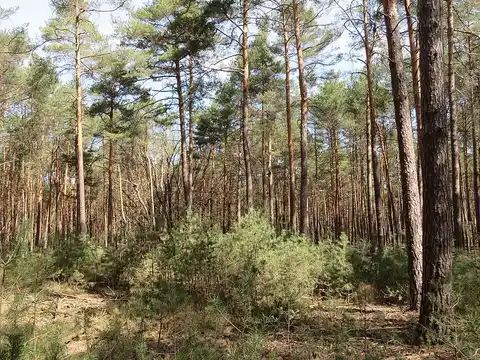
The orange-trunked pine, from Portugal to Russia’s Pacific.
- ADULT SIZE
- Up to 35 m, the bole often bare, crooked near the top.
- LEAVES
- Needles in pairs, short (4–7 cm), blue-green, bunched towards the top.
- BARK
- Bright orange and papery on the upper trunk — the tell seen from afar; grey and scaly at the base.
- FRUIT
- Small dull cones 3–7 cm long, hanging.
- IN PLAY
- That orange upper trunk in an open forest signs the Baltics, Scandinavia, Russia — the widest range of any pine. In Spain it climbs into the mountains.
- NATIVE
- Albania · Austria · Belgium · Bosnia and Herzegovina · Bulgaria · Croatia · Czech Republic · Estonia · Finland · France · Georgia · Germany · Greece · Hungary · Ireland · Italy · Kazakhstan · Kosovo · Latvia · Lithuania · Luxembourg · Mongolia · Montenegro · Netherlands · North Macedonia · Norway · Poland · Romania · Russia · Serbia · Slovakia · Slovenia · Spain · Sweden · Switzerland · Turkey · Ukraine · United Kingdom
Mediterranean cypress
Cupressus sempervirens · Columnar conifer
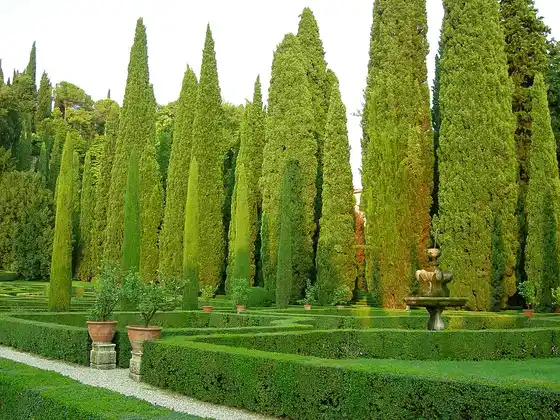
The dark flame of Tuscan drives and Mediterranean cemeteries.
- ADULT SIZE
- Up to 35 m. The cultivated form is fastigiate: a crown often less than a tenth as wide as the tree is tall.
- LEAVES
- Scale leaves 2–5 mm long on rounded shoots, in dense dark green sprays.
- FRUIT
- An ovoid cone 25–40 mm long with 10–14 scales, green at first and brown 20–24 months after pollination.
- IN PLAY
- A silhouette nothing else copies, readable a hundred metres off. Planted, so it follows people: drives, cemeteries, windbreaks — Portugal to Iran, plus California and central Chile.
- NATIVE
- Greece · Israel · Jordan · Lebanon · Turkey
Monkey puzzle tree
Araucaria araucana · Candelabra conifer
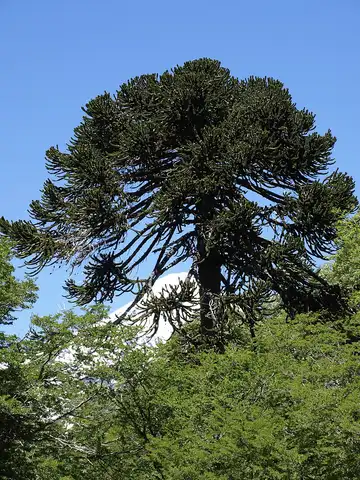
The candelabra of the southern Andes, and nowhere else.
- ADULT SIZE
- Some 30–40 m tall, with a trunk 1–1.5 m across.
- LEAVES
- Triangular scale leaves 3–4 cm long with sharp edges and tips, which stay attached for up to 24 years and cover nearly the whole tree.
- BARK
- Thick, up to 15 cm — probably an adaptation to wildfire.
- FRUIT
- A globose female cone 12–20 cm across holding about 200 seeds; it disintegrates when ripe and releases nut-like seeds 3–4 cm long.
- IN PLAY
- In its native range it is nearly an answer on its own: the Andes of Araucanía, between Chile and Argentina. But it is a park tree all over oceanic Europe — check whether the setting is mountain forest or a garden.
- NATIVE
- Argentina · Chile
Monterey pine
Pinus radiata · Candelabra conifer
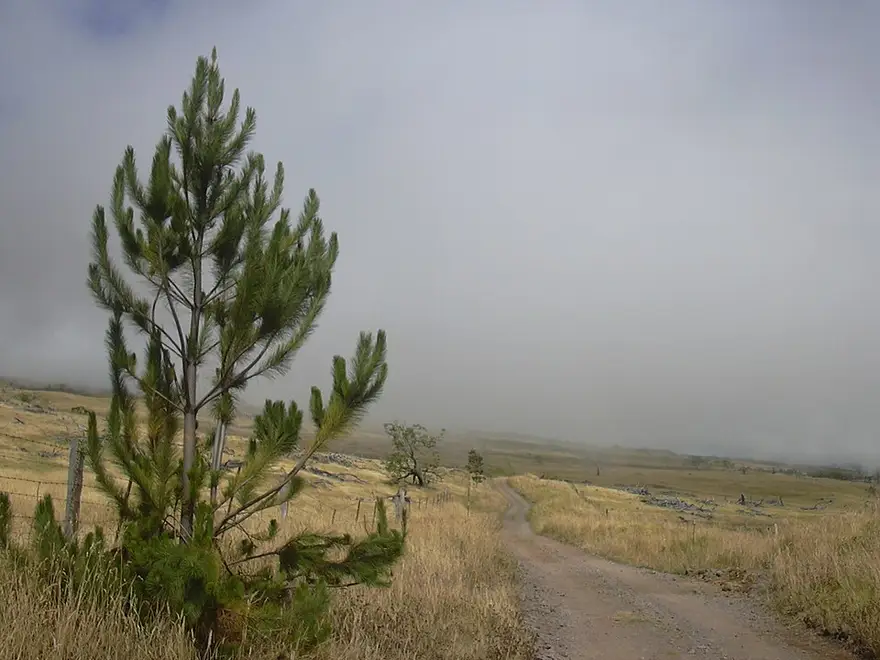
Native to a Californian speck, planted all over the southern hemisphere.
- ADULT SIZE
- 15–30 m tall in the wild, up to 60 m in cultivation.
- LEAVES
- Bright green, slender needles in threes, 8–15 cm long.
- BARK
- Fissured, dark grey to brown.
- FRUIT
- Brown ovoid cones 7–17 cm, asymmetrical, attached to the branch at an angle.
- IN PLAY
- The pale area is what matters: it makes up 89% of New Zealand’s planted forests, over half of Chile’s, and covers Australia, Spain and South Africa. Pines in rows in a southern landscape are often this one.
- NATIVE
- Mexico · United States of America
Norway spruce
Picea abies · Columnar conifer
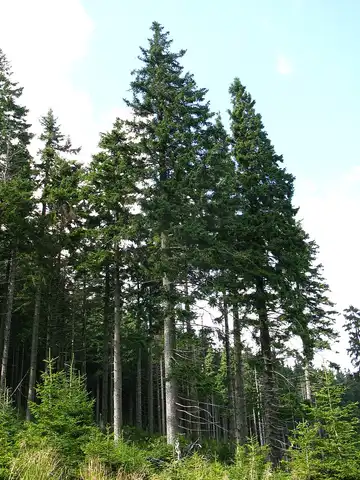
The Norway spruce: the dark spire of central and northern Europe’s forests.
- ADULT SIZE
- 30–50 m, with a regular spired top.
- LEAVES
- Short prickly needles borne singly; side branchlets often HANGING in curtains.
- BARK
- Red-brown, in fine rounded scales.
- FRUIT
- Long hanging cones 10–20 cm — the largest of any spruce.
- IN PLAY
- Whole slopes of even dark spires: the Alps, Scandinavia, central Europe — and every upland plantation. Its hanging curtains tell it from firs, flat and upright.
- NATIVE
- Albania · Austria · Bosnia and Herzegovina · Bulgaria · Croatia · Czech Republic · Estonia · Finland · France · Germany · Greece · Hungary · Italy · Kosovo · Latvia · Lithuania · Montenegro · North Macedonia · Norway · Poland · Romania · Russia · Serbia · Slovakia · Slovenia · Sweden · Switzerland · Turkey · Ukraine
Douglas fir
Pseudotsuga menziesii · Columnar conifer
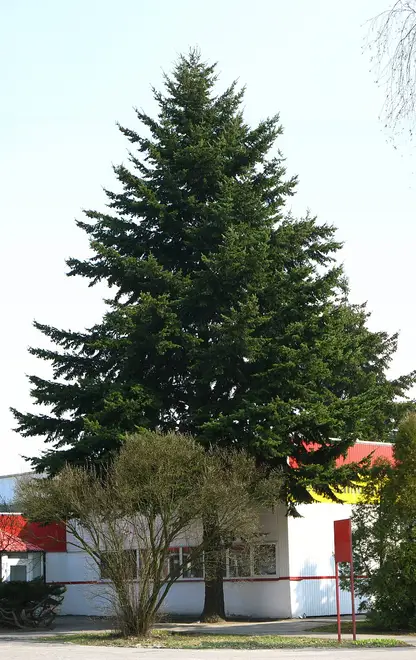
The Douglas fir: giant of the American West, replanted across Europe.
- ADULT SIZE
- 40–60 m and far more at home — among the tallest trees on earth.
- LEAVES
- Soft fragrant needles, branches in dark tiers.
- BARK
- Thick, corky, deeply furrowed when mature.
- FRUIT
- Hanging cones with protruding three-pointed bracts — the ‘mouse tails’.
- IN PLAY
- The giant tree-walls of Oregon and British Columbia — and, in Europe, the replanted stands too tall and too dark to be native (Massif central, Vosges, Scotland).
- NATIVE
- Canada · Mexico · United States of America
Eastern white pine
Pinus strobus · Candelabra conifer
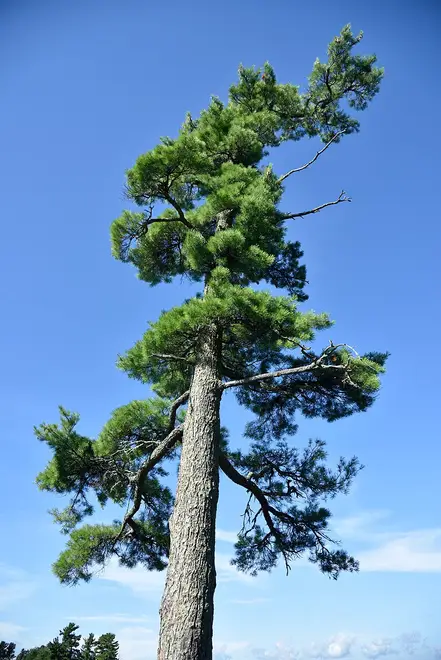
The eastern white pine: soft paddles of the American North-East.
- ADULT SIZE
- 30–50 m — the tall pine of the East, bushy from the base given room.
- LEAVES
- Needles in FIVES, fine, soft and bluish — foliage in gentle horizontal layers, ‘paddle-like’.
- FRUIT
- Long curved cones 8–20 cm, often resin-flecked.
- IN PLAY
- Its soft tiers over lakes and roads of the North-East: New England, the Great Lakes, Québec and Ontario. The classic mix-up is loblolly pine — which lives in the South-East.
- NATIVE
- Canada · United States of America
Japanese cedar
Cryptomeria japonica · Columnar conifer
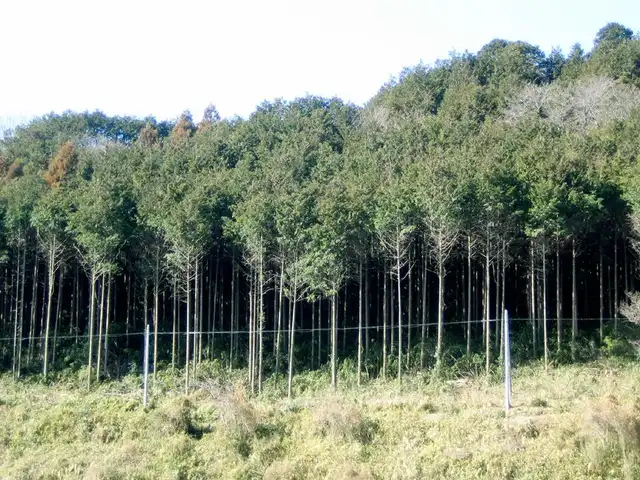
The sugi: the sacred column of Japan’s mountains.
- ADULT SIZE
- Up to 40–50 m, on a straight massive bole.
- LEAVES
- Short awl-shaped needles spiralling round the shoots — the foliage looks braided.
- BARK
- Red-brown, fibrous, peeling in long vertical strips.
- IN PLAY
- Japanese slopes in ranks of dark columns, and shrine avenues: rural Japan in one tree. Also planted through Indian tea hills and the Azores.
- NATIVE
- Japan
Loblolly pine
Pinus taeda · Candelabra conifer
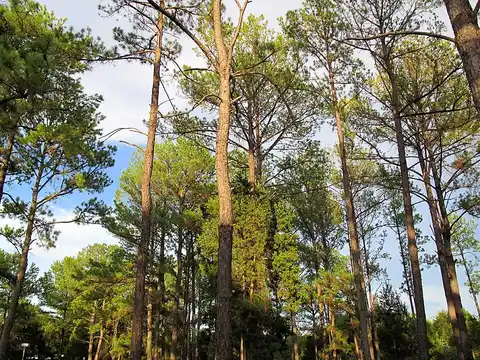
The loblolly pine: endless plantations of the American South-East.
- ADULT SIZE
- 25–35 m, a long bare bole with a ragged crown pushed high.
- LEAVES
- Needles in threes, 12–22 cm, in untidy pompoms.
- BARK
- Thick, in scaly red-brown plates.
- IN PLAY
- The scruffy pine wall along Georgia, Alabama and Carolina roads — the timber tree of the US South. Red dirt + loblolly = the Deep South-East.
- NATIVE
- Mexico · United States of America
Mexican cypress
Hesperocyparis lusitanica · Columnar conifer
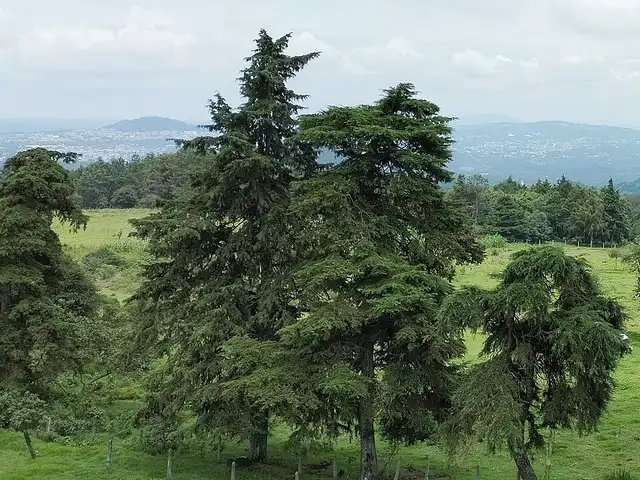
The Mexican cypress, hedge and farm timber of tropical highlands.
- ADULT SIZE
- Up to 30 m, densely conic, often clipped into hedges.
- LEAVES
- Blue-green scale foliage, shoot tips drooping.
- IN PLAY
- The dark hedgerows of the altiplanos: Mexico, Guatemala, and planted across East Africa and the Andes — a cypress at 2,500 m in the tropics is usually this one.
- NATIVE
- Costa Rica · Guatemala · Mexico
Khasi pine
Pinus kesiya · Candelabra conifer
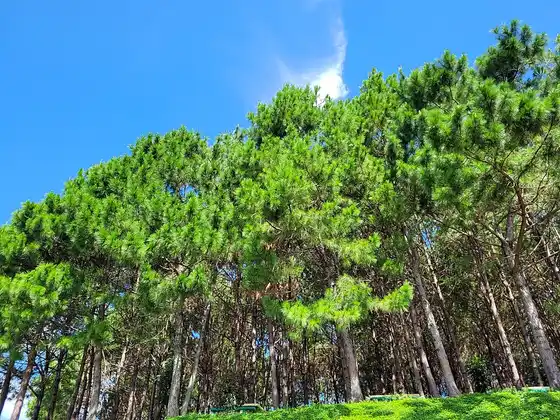
The Khasi pine: the highland pine woods of South-East Asia.
- ADULT SIZE
- 20–35 m, tall and thin, with a rounded untidy crown.
- LEAVES
- Needles in threes, fine and soft, in rounded pompoms.
- IN PLAY
- A pine in tropical Asia means altitude: Baguio in the Philippines, Burmese and Yunnan plateaus, the Khasi hills — the mix-up is chir pine, sparser, on the Himalayan side.
- NATIVE
- Bangladesh · Bhutan · Cambodia · India · Laos · Philippines · Thailand · Vietnam
Balsam fir
Abies balsamea · Columnar conifer
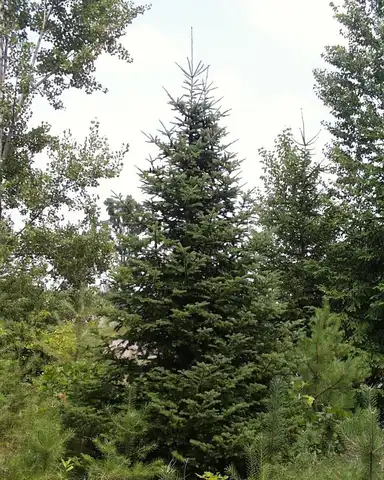
The balsam fir: the perfect triangle of Canadian forests.
- ADULT SIZE
- 15–25 m, a dense and regular triangular outline.
- LEAVES
- Flat, soft needles set flat along the shoot, strongly fragrant.
- FRUIT
- UPRIGHT purplish cones — firs carry their cones standing.
- IN PLAY
- It GROWS from Alberta to Newfoundland (the range is broad, and correct) — but only in NEWFOUNDLAND does it rule the roadside alone; elsewhere it mixes with spruce and birch. A uniform wall of dense triangles therefore leans hard toward Newfoundland and the Maritimes.
- NATIVE
- Canada · United States of America
Ponderosa pine
Pinus ponderosa · Candelabra conifer
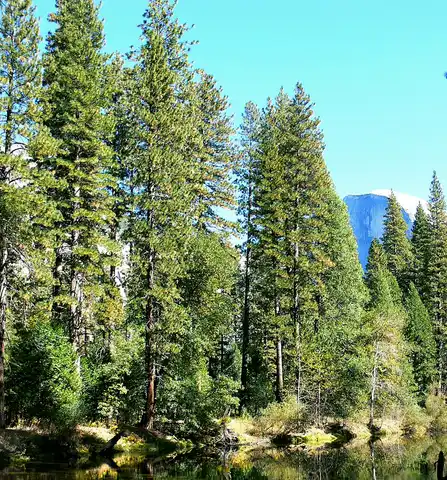
The ponderosa: red trunk and drooping pompoms of the American West.
- ADULT SIZE
- 30–50 m, straight-boled, with an open crown.
- LEAVES
- Long needles in threes, in drooping pompoms, fresh green.
- BARK
- Orange-red in jigsaw plates when mature, near-black when young — and vanilla-scented.
- IN PLAY
- Open dry forests of red trunks: the Rockies, the Colorado plateau, eastern Oregon — the western-movie pine. Dark young stands lean toward Mexico’s Durango.
- NATIVE
- Canada · United States of America
Chir pine
Pinus roxburghii · Candelabra conifer
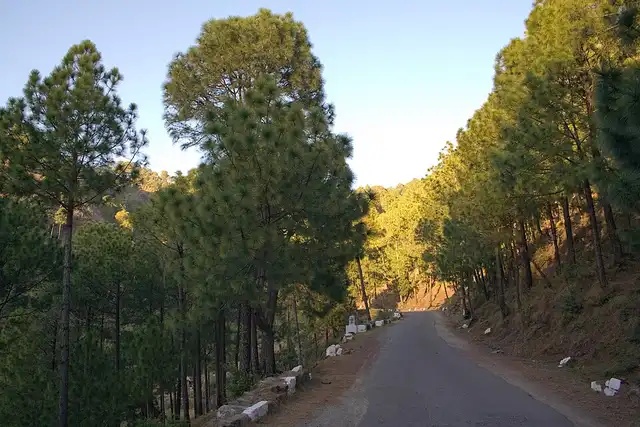
The chir pine: the pine belt of the middle Himalaya.
- ADULT SIZE
- 30–50 m, tall and thin, with a rounded sparse crown.
- LEAVES
- Very long needles in threes (20–35 cm), sparse and drooping.
- BARK
- Thick, deeply cracked into reddish plates.
- IN PLAY
- The open slopes at 500–2,000 m in Nepal, Uttarakhand and Himachal — a lanky pine on an Indian mountain road is this one nine times in ten.
- NATIVE
- Bangladesh · Bhutan · India · Nepal
Aleppo pine
Pinus halepensis · Candelabra conifer
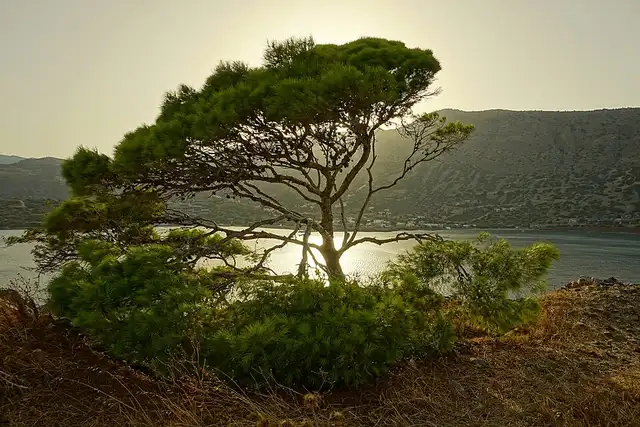
The Aleppo pine: the pale green of Mediterranean hills.
- ADULT SIZE
- 15–25 m, often crooked, bushy from low down.
- LEAVES
- Needles in pairs, fine and VERY pale — the palest pine of the coast.
- BARK
- Silver-grey, then cracked red-brown.
- FRUIT
- Stalked conic cones bent back along the shoot.
- IN PLAY
- The scrub hills of Provence, Spain and Greece, between white limestone and sea — its pale green stands against the dark stone pine; in the eastern Mediterranean, think Turkish pine.
- NATIVE
- Albania · Austria · Bosnia and Herzegovina · Croatia · France · Greece · Israel · Italy · Jordan · Kosovo · Lebanon · Montenegro · North Macedonia · Serbia · Slovenia · Spain · Tunisia · Turkey
Himalayan cedar
Cedrus deodara · Columnar conifer
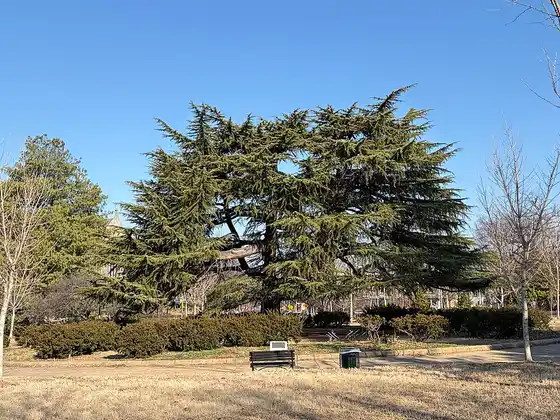
The deodar: the weeping cedar of the western Himalaya.
- ADULT SIZE
- 40–50 m at home, its leader and branch tips DROOPING.
- LEAVES
- Needles in rosettes on short spurs, blue-green.
- FRUIT
- Barrel-shaped upright cones that crumble on the tree.
- IN PLAY
- Its weeping tips set it apart from other cedars: Himachal and Kashmir forests, and an ornamental of mild-climate towns worldwide.
- NATIVE
- India · Nepal
Eastern red-cedar
Juniperus virginiana · Columnar conifer
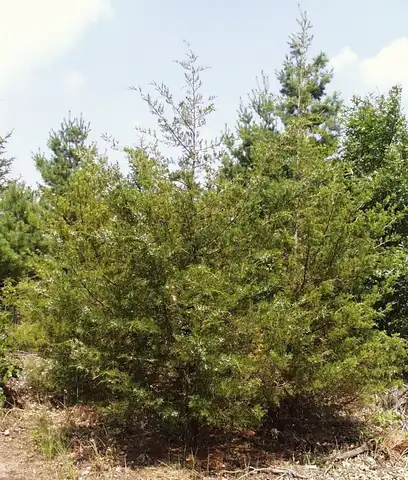
The red cedar: the small dark spindle of American fields and verges.
- ADULT SIZE
- 5–20 m, densely spindle-shaped from ground to tip.
- LEAVES
- Fine dark scale-leaves, not prickly when mature.
- FRUIT
- Small waxy blue ‘berries’ (fleshy cones).
- IN PLAY
- Dark spindles scattered through pastures and along fences of the US East and Midwest — the first tree to retake an abandoned field.
- NATIVE
- Canada · Mexico · United States of America
Stone pine
Pinus pinea · Umbrella conifer
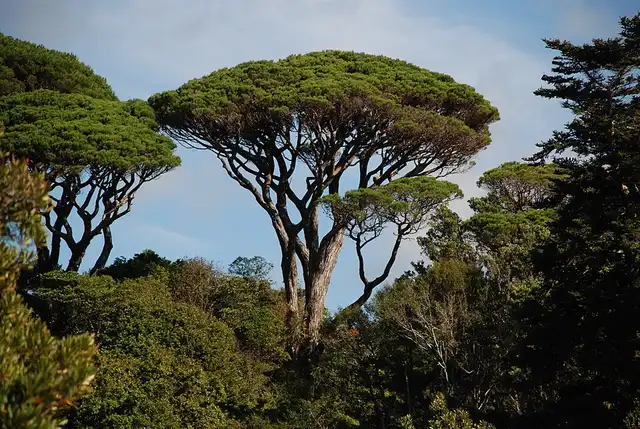
The Mediterranean umbrella pine, and the pine nut you eat.
- ADULT SIZE
- Usually 12–20 m, sometimes over 25; the mature crown is broad and flat, over 8 m wide.
- LEAVES
- Needles in bundles of two, 10–20 cm long; young trees bear single juvenile leaves 2–4 cm long.
- BARK
- Thick, red-brown, deeply fissured into broad vertical plates.
- FRUIT
- A broad ovoid cone 8–15 cm long, taking 36 months to ripen; the seed is 2 cm long with a powdery black coating.
- IN PLAY
- The only pine whose crown makes a parasol set high on a bare trunk: recognisable from far off, and Mediterranean almost everywhere it grows. Beware South African and central Chilean plantations, which share the climate and the tree.
- NATIVE
- Albania · France · Greece · Israel · Italy · Jordan · Kosovo · Lebanon · Montenegro · North Macedonia · Portugal · Spain · Turkey
Norfolk Island pine
Araucaria heterophylla · Candelabra conifer
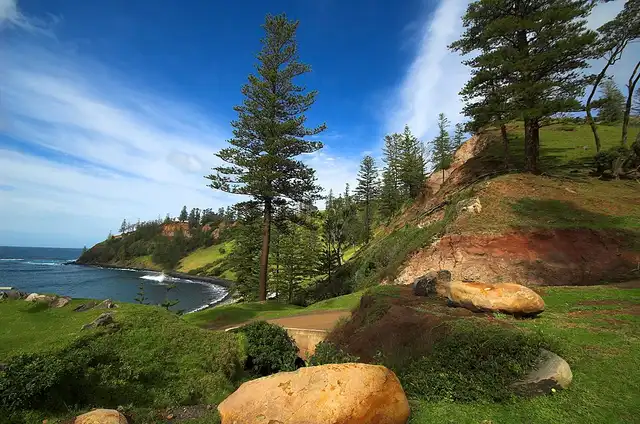
The perfectly tiered tree of subtropical seafronts.
- ADULT SIZE
- Up to 50–65 m, with a straight trunk and symmetrical branches.
- LEAVES
- Awl-shaped leaves 10–15 mm on young trees, incurved and shorter on old ones.
- BARK
- Grey-brown bark flaking finely; near-horizontal branches in tiers.
- FRUIT
- Squat globose cones 10–12 cm long, ripening in about 18 months.
- IN PLAY
- Endemic to a single island, planted wherever winters are mild and the sea is near: it says “seafront, Mediterranean or subtropical climate”, never the country. Its pagoda outline stands out from far away.
Paraná pine
Araucaria angustifolia · Umbrella conifer
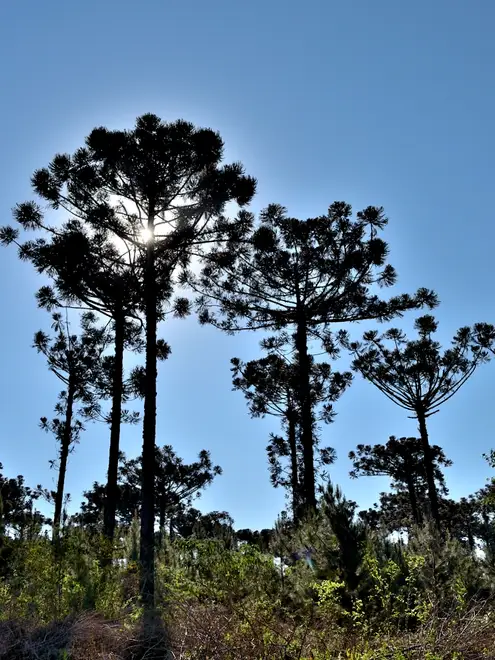
The Paraná pine: the flat candelabrum of southern Brazil.
- ADULT SIZE
- 25–40 m, a bare bole crowned by a flat umbrella of upturned branches.
- LEAVES
- Stiff, sharp lance-shaped needles, in tufts at the branch TIPS.
- FRUIT
- Large round cones with edible nuts (the pinhão).
- IN PLAY
- Its umbrella crown over green hills signs Paraná, Santa Catarina and Rio Grande do Sul — the Brazilian regional marker par excellence. Its braided cousin araucana says Chile.
- NATIVE
- Argentina · Brazil · Paraguay
Hoop pine
Araucaria cunninghamii · Columnar conifer
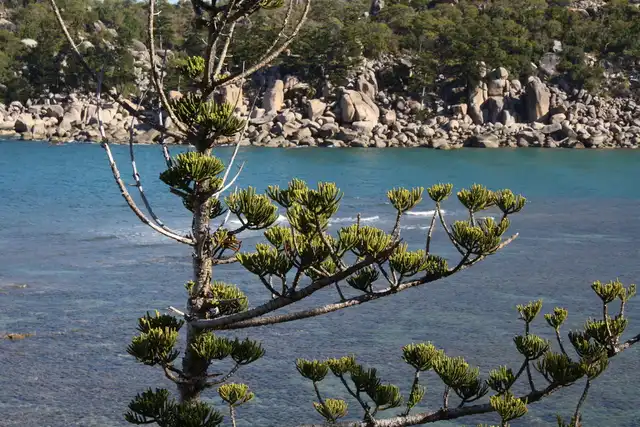
The hoop pine: the bushy araucaria of Australia’s east coast.
- ADULT SIZE
- 30–50 m, densely conic, with tufts at the branch tips.
- BARK
- Peels in fine horizontal hoops — hence the name.
- IN PLAY
- Its dark cones poking above the canopy say Queensland and northern New South Wales — plantation or forest. Bushier and less tiered than the Norfolk pine.
- NATIVE
- Australia · Indonesia
Cook pine
Araucaria columnaris · Columnar conifer
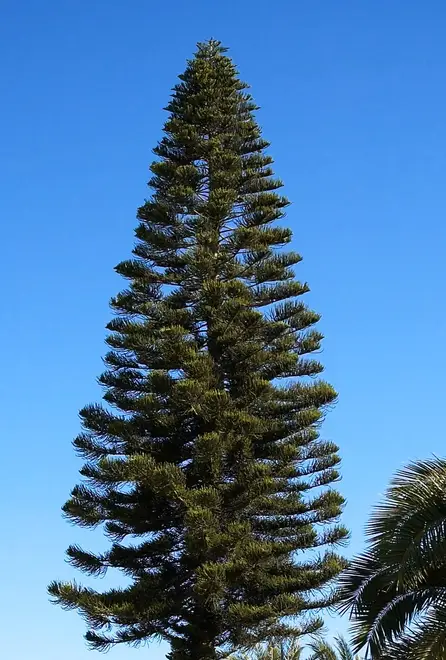
The Cook pine: the leaning column of New Caledonia.
- ADULT SIZE
- Up to 60 m at home, in a NARROW column — and often leaning towards the equator.
- LEAVES
- Short branches held close to the trunk, clad in scale-needles.
- IN PLAY
- The columns of New Caledonia’s lagoons — and, planted, of tropical towns worldwide where it is mistaken for the Norfolk pine: this one is narrower, less tiered, and leans.
Mexican weeping pine
Pinus patula · Candelabra conifer
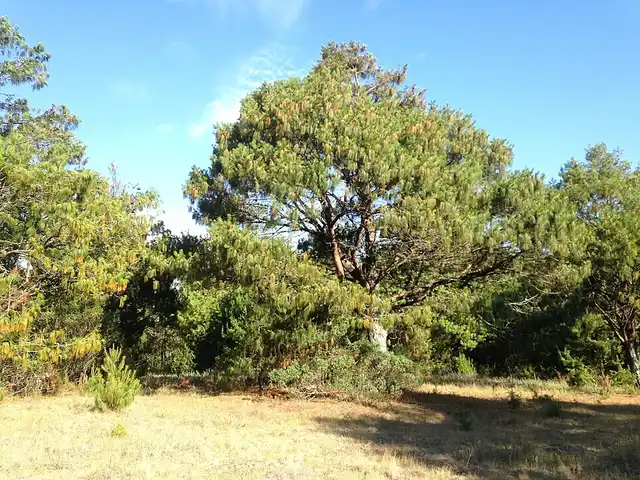
Mexico’s weeping pine, replanted on three continents.
- ADULT SIZE
- 20–35 m, with dense drooping foliage.
- LEAVES
- Very long fine HANGING needles, one of a kind — the tree seems to stream.
- BARK
- Reddish and papery on the upper trunk.
- IN PLAY
- Native to Mexico’s sierras, but its real card is the PLANTATION: Peruvian and Ecuadorian Andes, Eswatini and South Africa, East African highlands — a weeping pine outside Mexico says a highland plantation.
- NATIVE
- Mexico
Black pine
Pinus nigra · Candelabra conifer
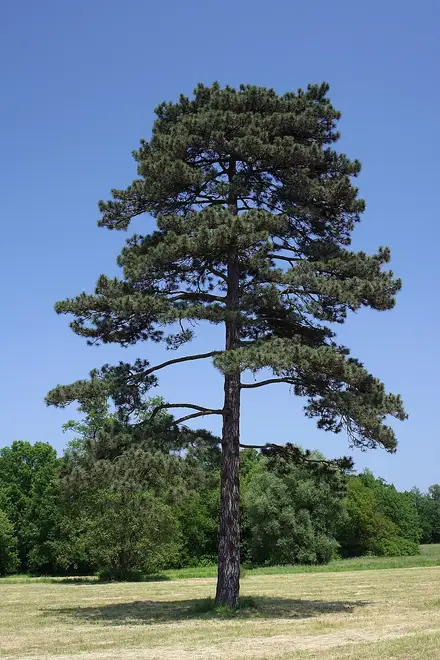
The black pine: dark, tiered, often wind-twisted.
- ADULT SIZE
- 20–40 m, with branches in dark tiers.
- LEAVES
- Needles in pairs, long, stiff and VERY dark green.
- BARK
- Grey-black, in fissured plates.
- IN PLAY
- Its dark mass on limestone uplands: Austria, the Balkans, Corsica (the laricio), Anatolia — and French mountain reforestations. Blacker than maritime pine, lower than Scots.
- NATIVE
- Albania · Austria · Bosnia and Herzegovina · Bulgaria · Croatia · Czech Republic · France · Germany · Greece · Hungary · Italy · Kosovo · Montenegro · North Macedonia · Romania · Russia · Serbia · Slovenia · Spain · Turkey · Ukraine
Turkish pine
Pinus brutia · Candelabra conifer
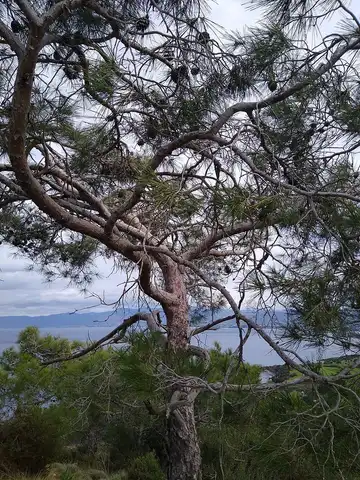
The Turkish pine: pine of the Aegean and Anatolian coasts.
- ADULT SIZE
- 15–30 m, bushy above, more upright than the Aleppo pine.
- LEAVES
- Needles in pairs, light green, longer and fuller than Aleppo’s, in light paddles.
- FRUIT
- Cones STALKLESS, held out or forward — the reverse of Aleppo.
- IN PLAY
- THE pine of Turkish roads, from Crete to Cyprus and the Levantine coast: east of Greece’s meridian, an ‘Aleppo pine’ is nearly always brutia.
- NATIVE
- Bulgaria · Georgia · Greece · Israel · Jordan · Lebanon · Romania · Russia · Turkey
Longleaf pine
Pinus palustris · Candelabra conifer
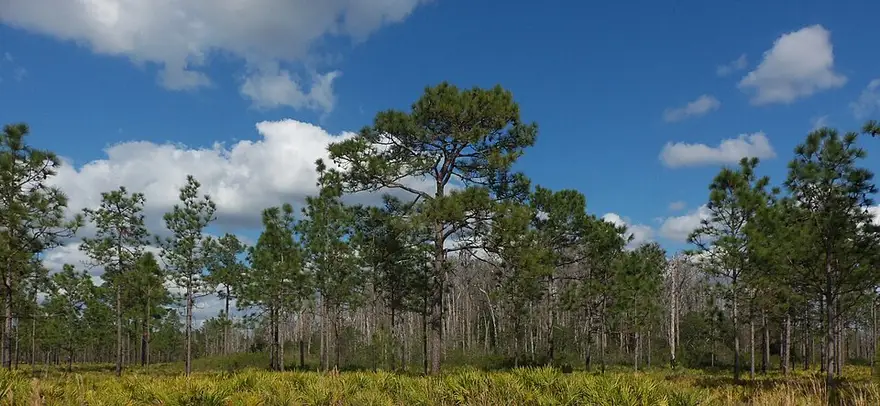
The longleaf pine: round pompoms and bare boles of the Deep South.
- ADULT SIZE
- 30–35 m, very tall and thin, with a sparse crown.
- LEAVES
- North America’s longest needles (20–45 cm), in threes, in perfectly ROUND pompoms.
- IN PLAY
- Open pine savannas on sand with grassy understorey: south Georgia, the Florida panhandle, Alabama — the South’s historic ecosystem, airier than loblolly plantations.
- NATIVE
- Mexico · United States of America
Pines
Pinus · Candelabra conifer
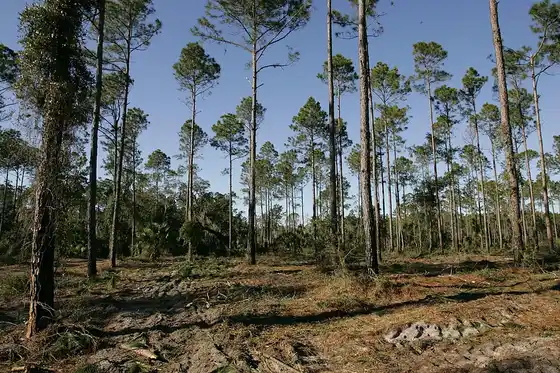
The pines: bundled needles, resin, and half of forest region-guessing.
- LEAVES
- Needles bound in bundles of 2, 3 or 5 — the count is a first species sort.
- FRUIT
- The woody cone, whose size and shape sign each species.
- IN PLAY
- The catch-all for doubtful cases: when the species won’t name itself, the SILHOUETTE (bushy-low, paddle-shaped, pompomed) plus context already gives a continent. The species sheets take over from there.
- NATIVE
- Albania · Austria · Bangladesh · Belgium · Bhutan · Bosnia and Herzegovina · Bulgaria · Cambodia · Canada · Costa Rica · Croatia · Czech Republic · Dominican Republic · Estonia · Finland · France · Georgia · Germany · Greece · Guatemala · Hungary · India · Indonesia · Ireland · Israel · Italy · Japan · Jordan · Kazakhstan · Kosovo · Laos · Latvia · Lebanon · Lithuania · Luxembourg · Mexico · Mongolia · Montenegro · Nepal · Netherlands · North Macedonia · Norway · Philippines · Poland · Portugal · Romania · Russia · Serbia · Slovakia · Slovenia · South Korea · Spain · Sweden · Switzerland · Taiwan · Thailand · Tunisia · Turkey · Ukraine · United Kingdom · United States of America · Vietnam
She-oak
Casuarina · Candelabra conifer
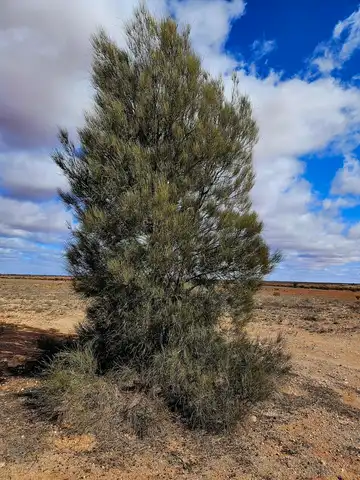
The she-oak: a false conifer whose ‘needles’ are twigs.
- ADULT SIZE
- 10–30 m, loose-limbed, often leaning in the sea wind.
- LEAVES
- Fine jointed green twigs stand in for foliage — the tree looks blurred, like green smoke.
- FRUIT
- Small woody cone-like fruits, true to the false-conifer act.
- IN PLAY
- The hazy curtain of tropical beaches: Australian, South-East Asian and Indian-Ocean shores — planted as a windbreak on every warm coast.
- NATIVE
- American Samoa · Australia · Bangladesh · Bhutan · Cambodia · Guam · India · Indonesia · Laos · Malaysia · Northern Mariana Islands · Philippines · Thailand · Vietnam
Sources and licences
Govaerts, R. et al. — World Checklist of Vascular Plants (WCVP), Royal Botanic Gardens, Kew. http://sftp.kew.org/pub/data-repositories/WCVP/ — CC BY 4.0. Aires par pays botanique (WGSRPD niveau 3).
Sources: Abies balsamea · Araucaria angustifolia · Araucaria araucana · Araucaria columnaris · Araucaria cunninghamii · Araucaria heterophylla · Casuarina · Cedrus deodara · Cryptomeria · Cupressus sempervirens · Douglas fir · Hesperocyparis lusitanica · Juniperus virginiana · Longleaf pine · Picea abies · Pine · Pinus brutia · Pinus halepensis · Pinus kesiya · Pinus nigra · Pinus patula · Pinus pinaster · Pinus pinea · Pinus ponderosa · Pinus radiata · Pinus roxburghii · Pinus strobus · Pinus taeda · Scots pine