Cacti & succulents
Cacti and succulents sign drought. Cacti are American: a columnar cactus in a natural landscape means the Americas; elsewhere you mostly see prickly pears planted or escaped, from the Maghreb to South Africa. Aloes and candelabra euphorbias, for their part, are African.
Cardón guajiro
Stenocereus griseus
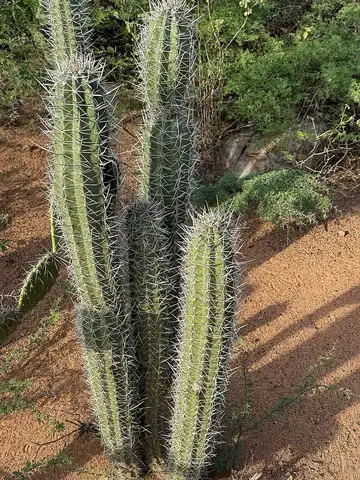
The Guajiro cardón: grey organ-pipes of the dry Caribbean coasts.
- ADULT SIZE
- 4–8 m, grey-green columns branching from the base.
- IN PLAY
- The column hedges and thickets of Colombia’s Guajira, coastal Venezuela and the ABC islands — often planted as living fences round corrals.
- NATIVE
- Brazil · Colombia · Curaçao · Guatemala · Mexico · Netherlands
Mandacaru
Cereus jamacaru
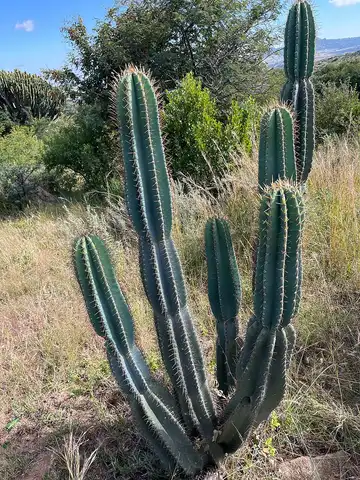
The mandacaru: the tall blue-green cactus of the sertão.
- ADULT SIZE
- 5–10 m, bluish sharply-ribbed columns branching like a tree.
- IN PLAY
- Emblem of the caatinga: standing by houses and in the dry scrub of Brazil’s Nordeste — mandacaru + facheiro + pale soil = sertão.
- NATIVE
- Brazil
Century plant
Agave americana
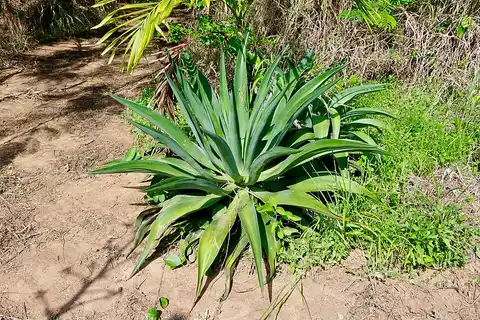
The century plant: the big bluish rosette of Mediterranean banks.
- ADULT SIZE
- A rosette 2–3 m across; an 8 m spike after ten to thirty years.
- LEAVES
- Large arching grey-blue leaves, often variegated in gardens.
- IN PLAY
- A Mexican naturalised on every Mediterranean coast for four centuries: on a Spanish, southern Italian or Greek bank it is local furniture in its own right.
- NATIVE
- Mexico · United States of America
Tree tumbo
Welwitschia mirabilis
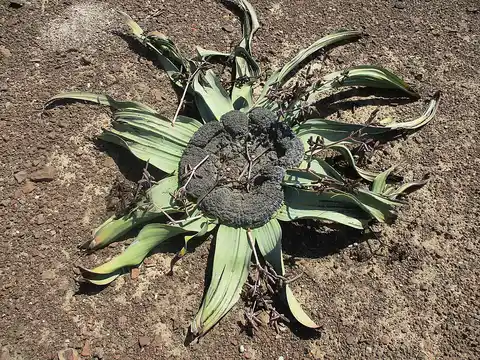
The welwitschia: two leaves for a thousand years, laid on the desert.
- ADULT SIZE
- Ground-hugging — a short stump-trunk and TWO strap leaves fraying for a lifetime.
- IN PLAY
- It lives ONLY in the Namib desert: its heaps of green straps on gravel sign Namibia (and coastal Angola) beyond appeal.
- NATIVE
- Namibia
Candelabra tree
Euphorbia ingens · Pad cactus
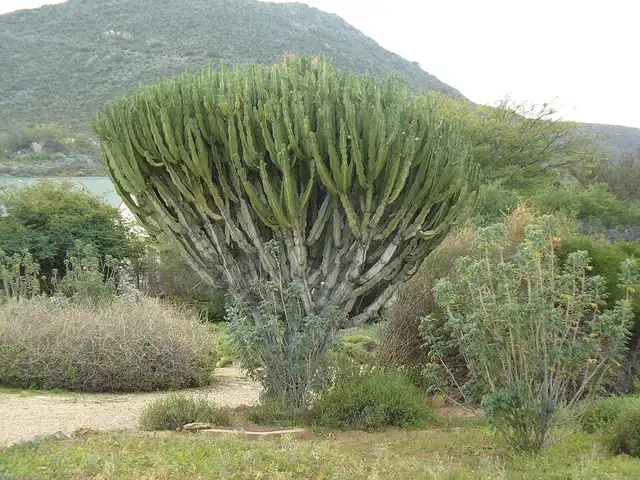
The candelabra tree: the great chandelier of South African hills.
- ADULT SIZE
- 6–12 m, a short trunk bearing a dense ball of upright fleshy limbs.
- IN PLAY
- Its dark chandeliers dot the bushveld: north-eastern South Africa, Zimbabwe, Mozambique — the ‘cactus’ of Kruger country, which is no cactus at all.
- NATIVE
- Botswana · Eswatini · Kenya · Lesotho · Namibia · Rwanda · South Africa · Uganda
Blue Weber agave
Agave tequilana
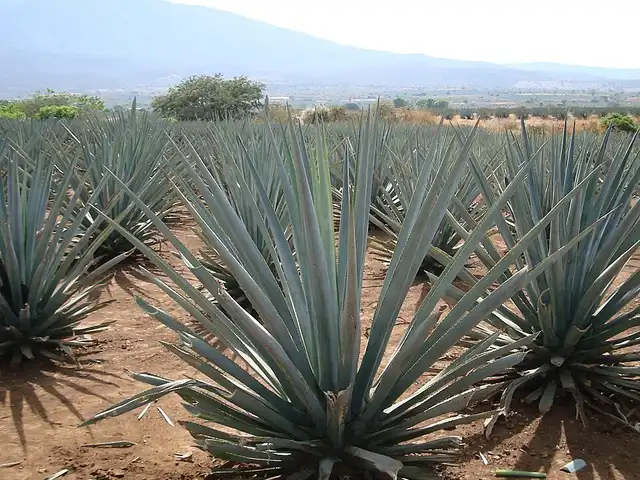
The blue agave: the metallic ranks of tequila fields.
- ADULT SIZE
- Rosettes 1.5–2 m across, a frank silver-blue.
- IN PLAY
- Whole hillsides in blue ranks: Jalisco and its surrounds — tequila’s appellation has listed landscapes, and they are on Street View.
- NATIVE
- Mexico
Elephant cactus
Pachycereus pringlei
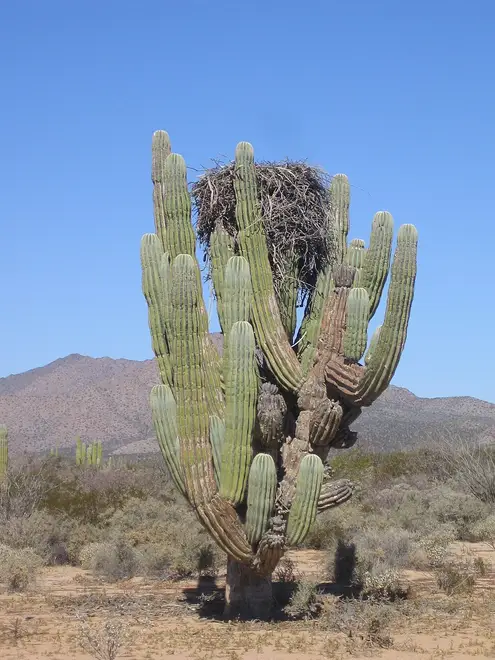
The elephant cardón: the most massive of cacti, keeper of Baja California.
- ADULT SIZE
- Up to 15–19 m — taller than the saguaro, its arms branching low like fingers.
- IN PLAY
- The column forests of the Baja peninsula and coastal Sonora — against Arizona’s saguaro, this one says MEXICO.
- NATIVE
- Mexico
Venezuelan prickly pear
Opuntia caracassana · Pad cactus
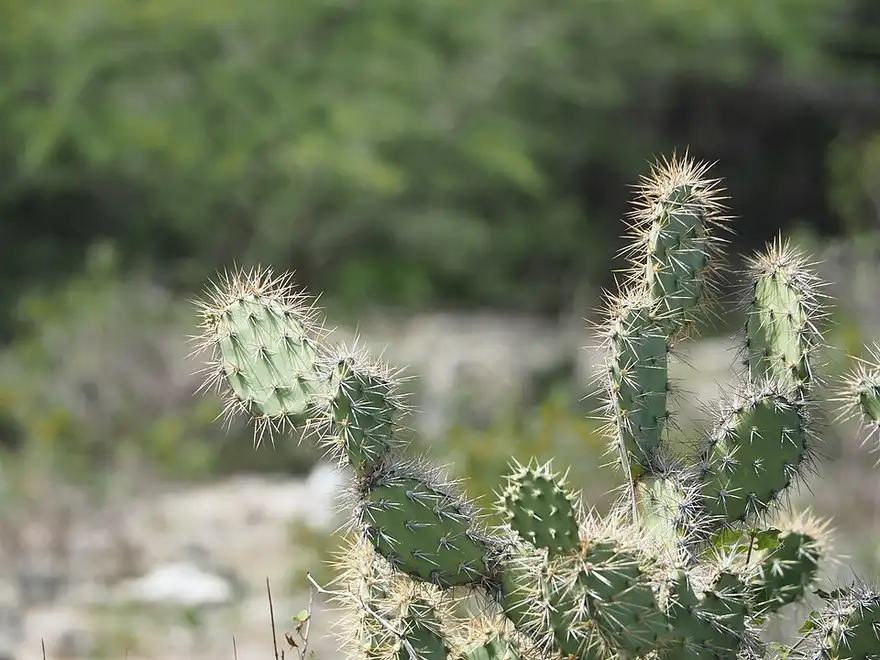
The Venezuelan prickly pear: pads of the Caribbean scrub.
- IN PLAY
- The prickly pear of Venezuela’s and Colombia’s dry coasts — with the Guajiro cardón it makes up the Guajira thorn scrub.
- NATIVE
- Brazil · Colombia · Curaçao · Netherlands
Tanaja
Browningia candelaris
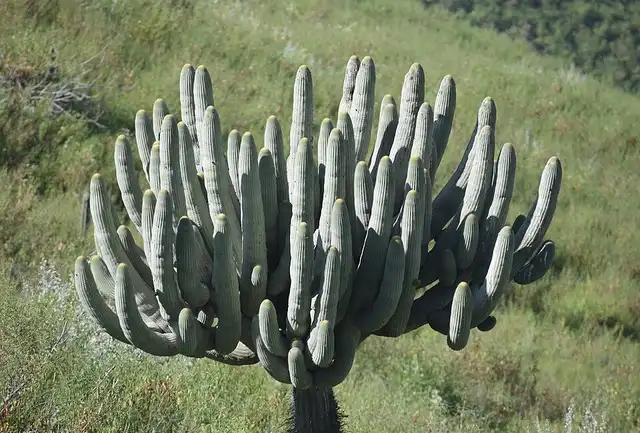
The candelabro: a spiny trunk, then a twisted crown of arms.
- ADULT SIZE
- 3–6 m — a single bole crowned by slim curving arms.
- IN PLAY
- It lives only on desert slopes between southern Peru and northern Chile: its bent-chandelier outline on scree signs Arequipa, Tacna or Arica.
- NATIVE
- Peru
Organ pipe cactus
Stenocereus thurberi
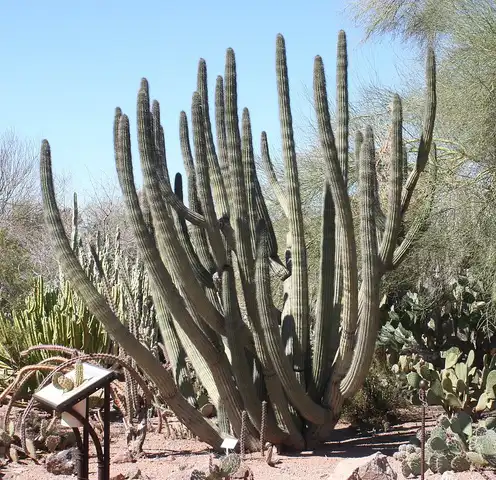
The organ pipe: curved pipes all rising from the ground.
- ADULT SIZE
- 3–7 m, many columns with NO common trunk, arching from the base.
- IN PLAY
- Mexican Sonora and Arizona’s far south — no trunk = organ pipe, a trunk with arms = saguaro: the sort takes one second.
- NATIVE
- Mexico · United States of America
Facheiro
Pilosocereus catingicola
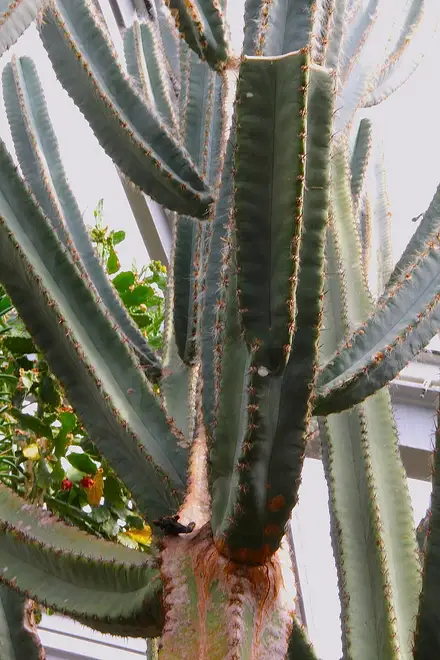
The facheiro: the woolly blue columns of the caatinga.
- ADULT SIZE
- 3–9 m, blue-green columns with woolly areoles.
- IN PLAY
- With the mandacaru, the other pillar of Brazil’s sertão — two blue cacti in grey thorn scrub: the Nordeste without hesitation.
- NATIVE
- Brazil
Quiver tree
Aloidendron dichotomum
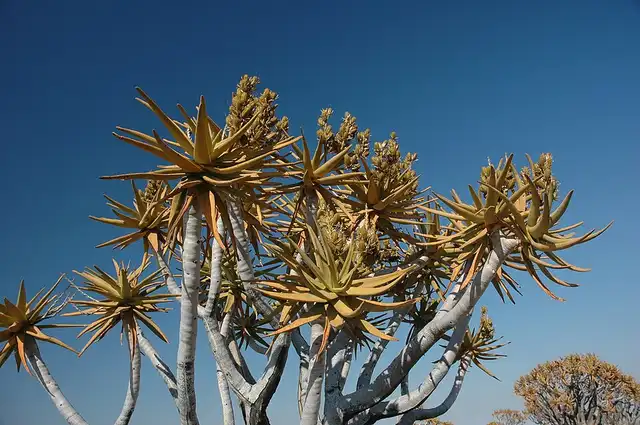
The quiver tree: the golden tree-aloe of Namibian deserts.
- ADULT SIZE
- 3–9 m, a smooth golden trunk forking evenly, rosettes at the tips.
- IN PLAY
- On rust-red scree, its giant-bonsai outline signs southern Namibia and Namaqualand — one of the most photogenic trees in the game.
- NATIVE
- Namibia · South Africa
Saguaro
Carnegiea gigantea
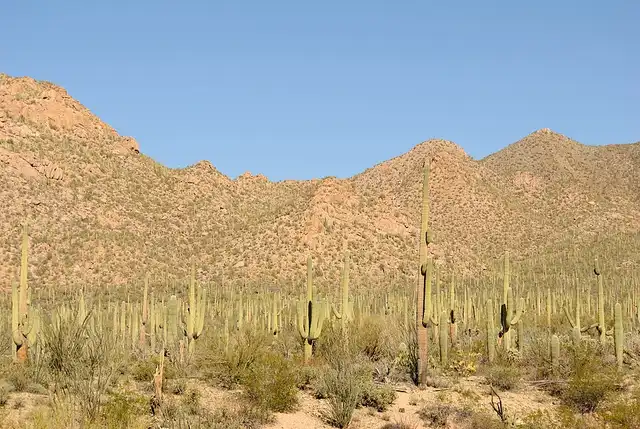
The saguaro: the armed cactus of the westerns — and of one desert only.
- ADULT SIZE
- 10–15 m, a single column that only raises arms after 70 years.
- IN PLAY
- It grows ONLY in the Sonoran desert: southern Arizona and Mexican Sonora. A saguaro rules out California, Texas and all the rest of the world — the game’s most famous endemic.
- NATIVE
- Mexico · United States of America
Candelabra cactus
Pachycereus weberi
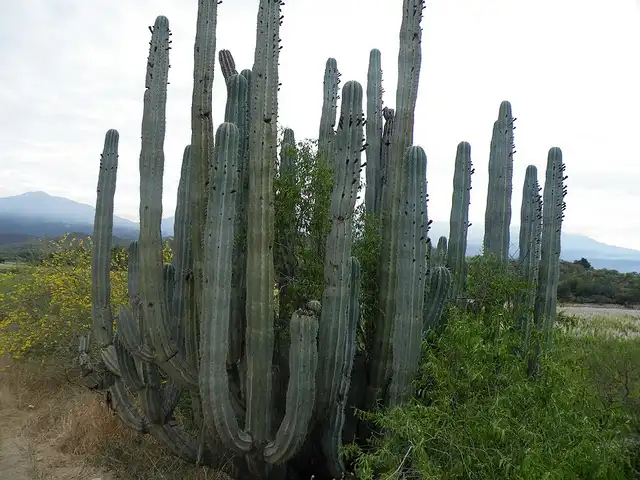
The Mexican candelabro: straight arms rising from a low trunk.
- ADULT SIZE
- Up to 10 m and more, a regular candelabrum of parallel limbs.
- IN PLAY
- The dry valleys of southern Mexico — Oaxaca, Puebla, the Tehuacán reserve: whole forests of candelabra, not to be confused with saguaro Sonora.
- NATIVE
- Mexico
Polylophus
Cephalocereus polylophus
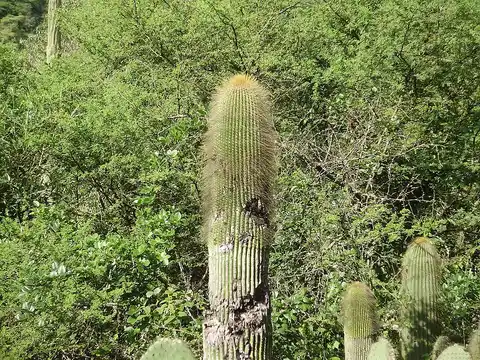
The straight cactus: one tall fluted column, armless.
- ADULT SIZE
- Up to 10 m and more — a single finely-ribbed shaft.
- IN PLAY
- The canyons of north-east Mexico (Hidalgo, Querétaro) — the lone armless column answering Baja’s ‘finger cactus’.
- NATIVE
- Mexico
Peruvian old man cactus
Espostoa lanata
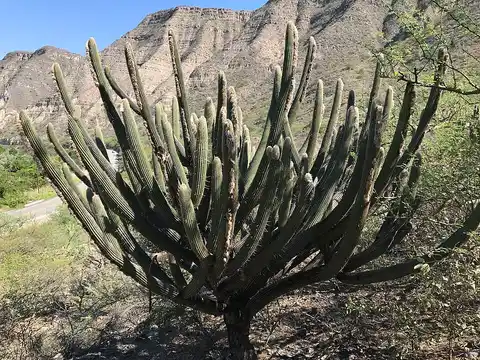
The woolly cactus: columns wrapped in white wool.
- ADULT SIZE
- 2–7 m, columns clothed in silky white felt.
- IN PLAY
- The dry inter-Andean valleys of northern Peru and southern Ecuador — white candles on ochre slopes, a crisp regional marker.
- NATIVE
- Colombia · Ecuador · Peru
Bitter aloe
Aloe ferox
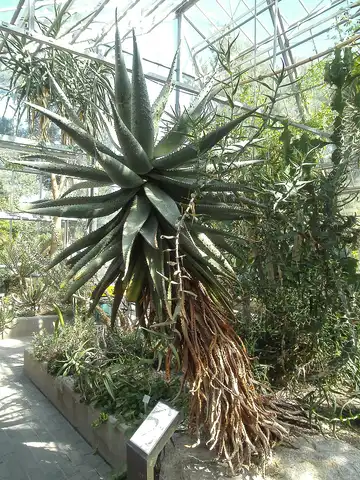
The bitter aloe: the red torch of Cape hillsides.
- ADULT SIZE
- 2–3 m, a single rosette atop a trunk skirted in dead leaves.
- FRUIT
- Candelabra of orange-red flowers raised in midwinter.
- IN PLAY
- Scattered on the slopes of South Africa’s southern coast (Western and Eastern Cape) — in flower May to August, it studs the Garden Route with red torches.
- NATIVE
- Lesotho · South Africa
Mountain aloe
Aloe marlothii
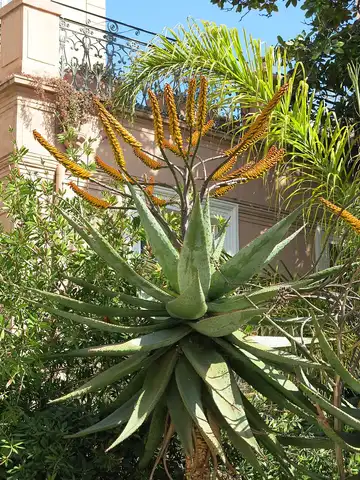
The mountain aloe: the slanted chandelier of the bushveld.
- ADULT SIZE
- 2–4 m, a single spiny rosette, dry-leaf skirt down the trunk.
- FRUIT
- Orange flower spikes held NEARLY HORIZONTAL — its signature against ferox.
- IN PLAY
- The hills of eastern South Africa — Mpumalanga, KwaZulu-Natal, Limpopo: south coast = ferox with upright torches, eastern interior = marlothii with lying arms.
- NATIVE
- Botswana · Eswatini · Lesotho · South Africa
Alastrado
Xiquexique gounellei · Pad cactus
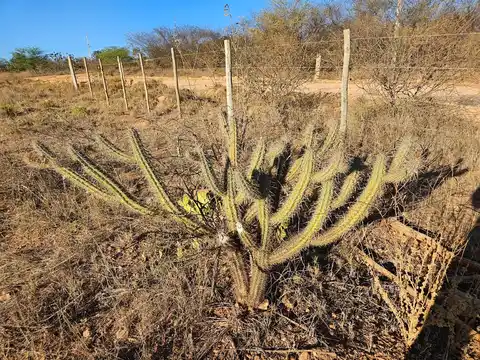
The alastrado: the sprawling cactus of the caatinga, its crooked arms turned skyward.
- ADULT SIZE
- 0.5–4 m, a much-branched shrub whose stems turn crooked or lie flat with age.
- FRUIT
- Large white funnel-shaped flowers, 4–9 cm long.
- IN PLAY
- The dry Brazilian Nordeste: on rock outcrops and along caatinga tracks, a low clump of grey-green columns that run sideways before turning upright — lower and wider than the mandacaru, which makes a tree. Always green, it stands out in the dry season (July to December), when the caatinga is leafless.
- NATIVE
- Brazil
Coral aloe
Aloe striata
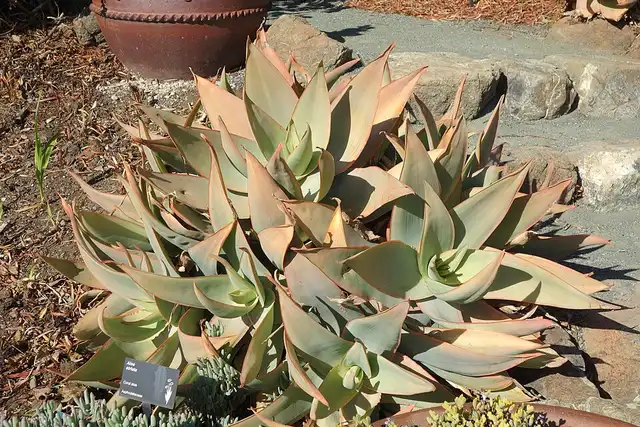
The coral aloe: a stemless rosette of smooth, pink-edged leaves.
- ADULT SIZE
- A small stemless aloe: a rosette sitting on the ground.
- LEAVES
- Blue-green, faintly lined, with a smooth pink margin — no teeth.
- FRUIT
- Red flowers.
- IN PLAY
- The rocky slopes of the Eastern Cape and the southern Western Cape, coast and Karoo: low, pale rosettes scattered among the stones, lighting up red in late austral winter. Lower than the bitter aloe, which grows a trunk.
- NATIVE
- South Africa
Transvaal candelabra tree
Euphorbia cooperi · Pad cactus
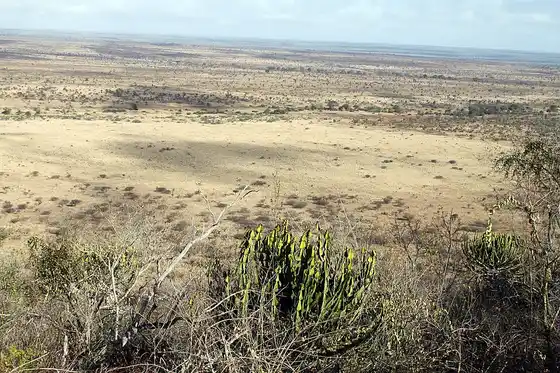
The Transvaal candelabra tree: a chandelier whose arms are stacks of segments.
- ADULT SIZE
- A shrub to 2 m or a tree to 6 m; branches of four to six angles, pinched into inverted-cone segments 10–50 cm long.
- IN PLAY
- The bushveld of north-eastern South Africa (Limpopo, Mpumalanga, northern KwaZulu-Natal), Eswatini and Mozambique, up to Zimbabwe and Malawi, on rocky hills. More open than the candelabra tree (E. ingens) and its dense ball: here a bare trunk carries a loose crown of upright arms, like strings of cones.
- NATIVE
- Botswana · Eswatini · Kenya · Lesotho · South Africa
Elephant salt salad
Mesembryanthemum barklyi
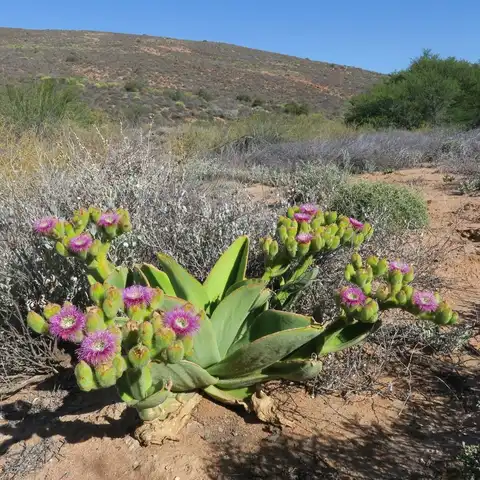
The elephant salt salad: a succulent shrub with large fleshy leaves.
- IN PLAY
- The arid Northern Cape and southern Namibia: a low, fleshy shrub, bright green or reddened by drought, along tracks and in gullies — far bulkier than the creeping ice plants of the coast.
- NATIVE
- Namibia · South Africa
Green/sweet noors
Euphorbia caerulescens/radyeri · Pad cactus
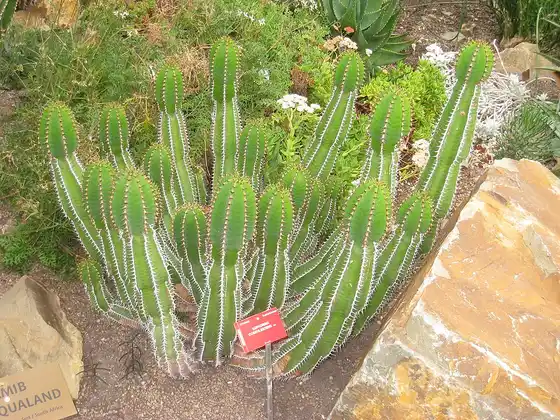
The noors: the blue-green thickets of the eastern Karoo, two euphorbias no one tells apart from the road.
- ADULT SIZE
- Up to 1.5 m for the green noors (E. caerulescens): a shrub branching from the base, with upright blue-green stems of four to six angles, cut into segments, with spines up to 12 mm.
- IN PLAY
- The Eastern Cape Karoo: low, dense sheets of angular blue-green stems covering whole slopes among the grey veld bushes. One card for two species, the green (E. caerulescens) and the sweet (E. radyeri) noors: same habit, same country — in game the landscape matters, not the epithet.
- NATIVE
- South Africa
Prickly pear
Opuntia · Pad cactus
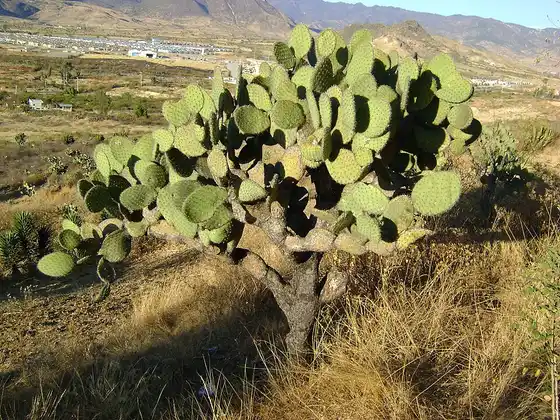
The pads of the prickly pear, Mexican by origin.
- ADULT SIZE
- Opuntia ficus-indica forms a trunk and may reach 5–7 m, with a crown over 3 m across and a trunk 1 m thick.
- LEAVES
- No leaves but cladodes: flat rounded pads, green to blue-green, bearing large fixed spines and small hairlike prickles — glochids — that catch on skin. Some forms are spineless.
- FRUIT
- The fruit may be red, wine-red, green or yellow-orange.
- IN PLAY
- It is naturalised right around the Mediterranean, in North Africa, the Near East, South Africa and Australia: it says hot and dry, not Mexico. Planted as a hedge on a bank it is human landscaping, not local flora.
- NATIVE
- Argentina · Bolivia · Brazil · Canada · Colombia · Costa Rica · Curaçao · Dominican Republic · Ecuador · France · Guatemala · Mexico · Netherlands · Panama · Paraguay · Peru · Puerto Rico · Thailand · United States of America · Uruguay
Euphorbias
Euphorbia · Pad cactus
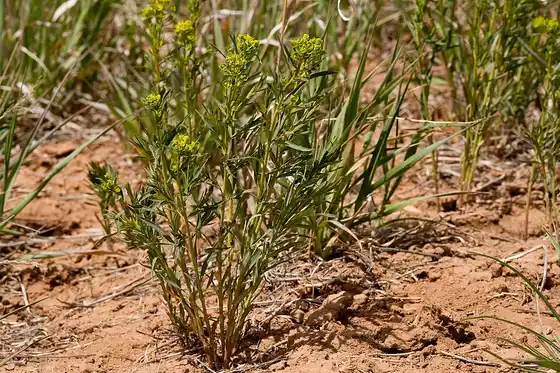
The tree euphorbias: the ‘cacti’ of the Old World.
- ADULT SIZE
- 2–15 m, in candelabra of fleshy ribbed stems, with white latex.
- IN PLAY
- The golden rule: a ‘cactus’ in AFRICA or India is a euphorbia — true cacti are American. Candelabra on dry hills say Kenya, Ethiopia, southern Africa.
- NATIVE
- Albania · American Samoa · Argentina · Australia · Austria · Bangladesh · Belgium · Bermuda · Bhutan · Bolivia · Bosnia and Herzegovina · Botswana · Brazil · Bulgaria · Cambodia · Canada · Chile · Colombia · Costa Rica · Croatia · Curaçao · Czech Republic · Denmark · Dominican Republic · Ecuador · Egypt · Estonia · Eswatini · Faroe Islands · Finland · France · Georgia · Germany · Ghana · Greece · Guam · Guatemala · Hungary · Iceland · India · Indonesia · Ireland · Israel · Italy · Japan · Jordan · Kazakhstan · Kenya · Kosovo · Kyrgyzstan · Laos · Latvia · Lebanon · Lesotho · Lithuania · Luxembourg · Madagascar · Malaysia · Mexico · Mongolia · Montenegro · Namibia · Nepal · Netherlands · New Zealand · Nigeria · North Macedonia · Northern Mariana Islands · Norway · Oman · Panama · Paraguay · Peru · Philippines · Poland · Portugal · Puerto Rico · Qatar · Romania · Russia · Rwanda · São Tomé and Príncipe · Senegal · Serbia · Slovakia · Slovenia · South Africa · South Korea · Spain · Sri Lanka · Sweden · Switzerland · Taiwan · Thailand · Tunisia · Turkey · Uganda · Ukraine · United Arab Emirates · United Kingdom · United States of America · Uruguay · Vietnam
Agaves
Agave
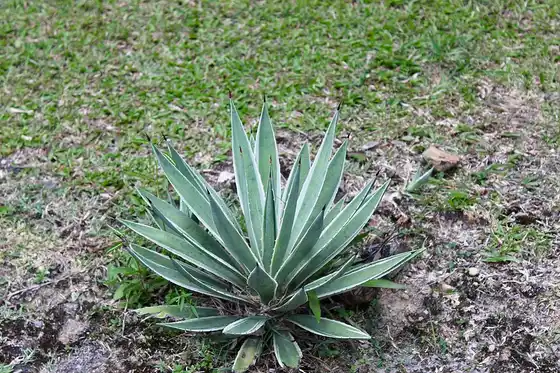
The agaves: armed rosettes, and one giant flowering spike.
- ADULT SIZE
- Rosettes 1–3 m; the single flower spike rises 4–9 m, then the plant dies.
- LEAVES
- Rigid fleshy leaves in a rosette, spiny-edged, needle-tipped.
- IN PLAY
- Mexican at heart, but naturalised all round the Mediterranean: a dry spike on a bank says Spain as easily as Oaxaca — context decides.
- NATIVE
- Brazil · Colombia · Costa Rica · Curaçao · Dominican Republic · France · Guatemala · Mexico · Netherlands · Panama · Puerto Rico · United States of America
Yuccas
Yucca
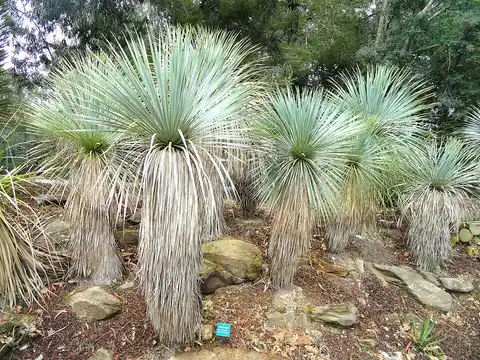
The yuccas: bayonet tufts and white flower candles.
- LEAVES
- Rosettes of stiff blade leaves, often atop a fibrous trunk.
- IN PLAY
- From the Mojave’s Joshua tree to roadside yuccas of Texas and Mexico — and planted in dry gardens worldwide. Wild and tree-like, it says the North American South-West.
- NATIVE
- Bermuda · Canada · Costa Rica · Guatemala · Mexico · Panama · United States of America
Sources and licences
Govaerts, R. et al. — World Checklist of Vascular Plants (WCVP), Royal Botanic Gardens, Kew. http://sftp.kew.org/pub/data-repositories/WCVP/ — CC BY 4.0. Aires par pays botanique (WGSRPD niveau 3).
Sources: Euphorbia caerulescens · Euphorbia cooperi · Agave · Agave americana · Agave tequilana · Aloe ferox · Aloe marlothii · Aloe striata · Aloidendron dichotomum · Browningia candelaris · Cereus jamacaru · Espostoa lanata · Euphorbia · Euphorbia ingens · Neobuxbaumia polylopha · Opuntia · Pachycereus pringlei · Pachycereus weberi · Pilosocereus · Saguaro · Stenocereus griseus · Stenocereus thurberi · Welwitschia · Xiquexique gounellei · Yucca